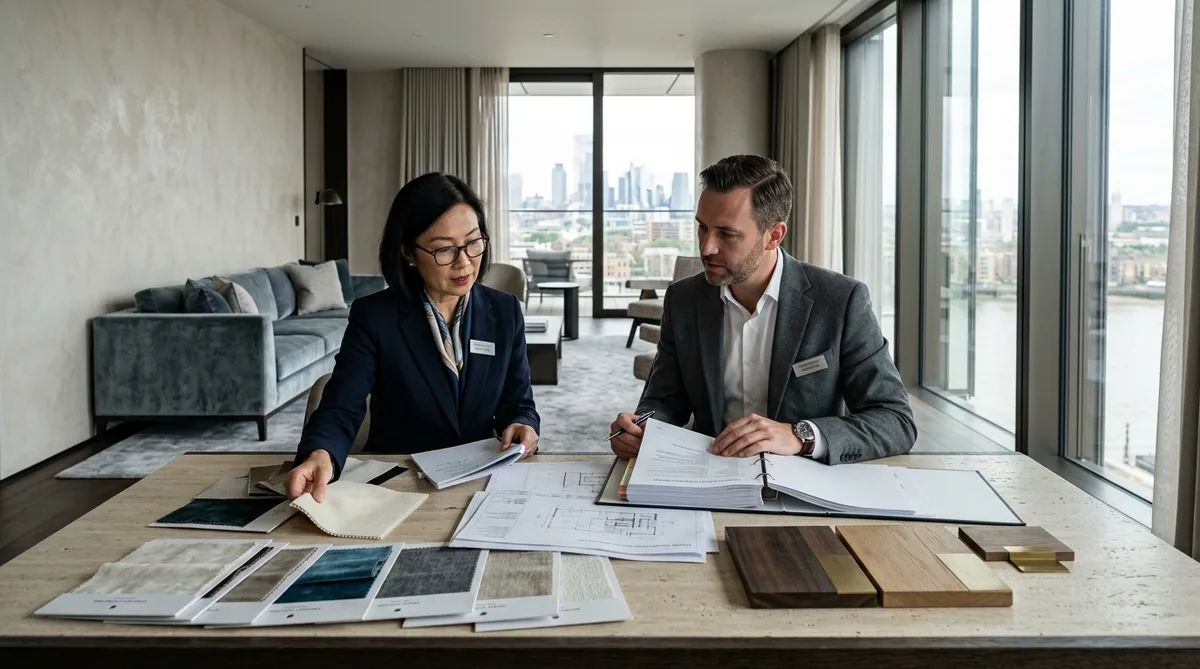
Can one schedule clear both a Marriott and a Hilton review? It can, provided it satisfies two sets of clauses that cite different test methods for the same property. Abrasion: Marriott cites Martindale 100,000 cycles, Hilton cites Wyzenbeek 100,000 double rubs. Flammability: BS 7176 Crib 5 or CAL 133 on one side, CAL 133 with TB 117-2013 on the other. Hardware life: DIN EN 15338 at 100,000 cycles and an 80,000-cycle damped rating do not come off the same report. The textile may well pass both; the pre-opening audit wants both certificates, plus a schedule written against the manual edition current at signature.
Brand operators set explicit physical performance benchmarks and safety documentation for loose FF&E, and projects supplied on residential habits tend to fail here. When the project reaches the Pre-opening Brand Audit / Technical Services Inspection, inspectors issue lists of Audit Deficiencies—such as textiles lacking a BS 7176 Crib 5 composite report, seating with no BIFMA 100,000-cycle fatigue record, undamped drawer slides, or VOC emissions over the limit. These failures trigger mandatory sample rejections, full-batch remanufacturing, and opening delays of 30 to 60 days, during which interest and fixed payroll continue against no room revenue.
The sections below break the Marriott, Hilton, IHG and Hyatt clauses into checks that can be signed off at the factory rather than argued at the mock-up room. The same matrix shows which clauses a Value Engineering review may meet by another method and which it may not touch.
1. Pre-Opening Brand Audit Delay Loss Mathematical Model
The figures that follow are a modelled scenario, not a measurement. Assumptions: 300 keys, ADR 6,000, target occupancy 65% (an opening ramp-up target, below the stabilised 75% our other models use), a NTD 3.0 billion loan at 3%. On those inputs, the daily sunk cost of an audit-triggered delay is:
+-------------------------------------------------------------------------+
|     Pre-Opening Brand Audit 4-Stage Rigid Verification Gateways         |
+-------------------------------------------------------------------------+
|  [Stage 1: 1:1 Mock-Up Room (MUR)] ──► Ergonomics/Hardware Destructive  |
|         │                                                               |
|         ▼                                                               |
|  [Stage 2: Mill Certificates] ───────► SGS/TÜV BS 7176 & BIFMA Reports  |
|         │                                                               |
|         ▼                                                               |
|  [Stage 3: Factory White-Body FAT] ──► 100% Pre-Assembly Quality Audit  |
|         │                                                               |
|         ▼                                                               |
|  [Stage 4: Job-Site Acoustic NC 25] ─► 100% Zero-Defect License Issued  |
+-------------------------------------------------------------------------+
Four Major International Hotel Portfolios: FF&E Compliance Matrix
| Technical Benchmark | Marriott International | Hilton Worldwide |
|---|---|---|
| 1. Structural Integrity | ANSI/BIFMA X5.1 / X5.4 | BIFMA Heavy-Duty 136kg |
| 2. Fire Safety Standard | BS 7176 Crib 5/CAL 133 | CAL 133 / TB 117-2013 |
| 3. Textile Abrasion | Martindale 100k+Crypton | Wyzenbeek 100k rubs |
| 4. Substrate Emission | JIS F☆☆☆☆ (<=0.3 mg/L) | TSCA Title VI / CARB P2 |
| 5. Hardware Lifecycle | DIN EN 15338 100,000 Cy | 80,000 Damped Cycles |
2. 4 Core Global Hotel Brand FF&E Quality Assurance SOPs
Brand manuals translate into the following quantifiable manufacturing and acceptance standards:
1. ANSI/BIFMA X5.1 / X5.4 Structural Fatigue Testing
- The acceptance tests for commercial armchairs and sofas are a 136 kg (300 lbs) vertical impact and 100,000 dynamic durability cycles. Carcasses use kiln-dried European Beech with double-doweled joinery and corner blocks.
2. British Standard BS 7176 Medium Hazard (Crib 5) Compliance
- Textiles, cold-cured foams and interliners are submitted to a third-party laboratory as a composite and reported against the 5.2 kW peak heat release Crib 5 wooden crib ignition test; a report on a single material does not stand in for the composite result.
3. Martindale ≥ 100,000-Cycle Stain & Abrasion Engineering
- Upholstery incorporates factory-bonded Crypton or Nanotex nanocoatings resisting coffee, wine, and oil stains while delivering 100,000 Martindale rubs, slashing housekeeping labor.
4. JIS F☆☆☆☆ Zero-Formaldehyde & Acoustic NC 25 Quiet Damping
- Substrates specify Japanese JIS F☆☆☆☆ multi-ply birch ( formaldehyde), shortening the pre-handover airing period; all cabinetry features soft-close hydraulic hinges and PTFE floor glides achieving NC 25 acoustic standards.
3. Actuarial Quantification: 300-Key Hotel Brand Compliance 10-Year Model
Modelled outcome for a 300-key new-build under the assumptions above:
300-Key Hotel Brand Audit Compliance Financial & TCO Actuary
| Actuarial Parameter | Non-Compliant Low-Bid | Built to Brand Clauses |
|---|---|---|
| Pre-Opening Audit Outcome | 15 Critical Deficiencies | Scenario: first-pass |
| Mandatory Batch Remake CapEx | NT$ 8,500,000 | NT$ 0 |
| 45-Day Opening Delay Sunk Loss | NT$ 28,125,000 (Lost) | NT$ 0 (Captured) |
| Initial Bid Price Difference | Appears NT$ 2.0M Lower | Baseline |
| 10-Year True Sunk Net Capital | Net Loss > NT$ 34.6M | Net Revenue Win |
On those assumptions, the NTD 2.0M saved at award is offset by roughly NTD 36,600,000 in remanufacturing and 45 days of lost room revenue. Shorten the delay to 15 days and the ranking reverses.
4. Total Cost of Ownership (TCO): Non-Compliant Low-Bid vs. Brand-Standard Build
10-Year TCO Evaluation: Non-Compliant Low-Bid vs. Brand-Standard Build
| Evaluation Vector | Non-Compliant Low-Bid | Brand-Standard Build |
|---|---|---|
| Pre-Opening Brand Audit | High risk of rejection | Submitted item by item with documents |
| Fire & VOC Documents | No reports | Third-party laboratory reports attached |
| Structural Durability | Nailed frames (Loosens in 1y) | BIFMA 100k Cycles |
| Acoustic Performance | Undamped hardware (Noisy) | Hydraulic + PTFE |
| 10-Year Cumulative TCO | Baseline (100% + Delays) | Reduced to 27% |
5. Conclusion: Confirm the Manual Version Before You Specify
In global luxury hospitality development, Brand Standards are not aesthetic constraints; they are the distilled operational wisdom of international luxury hoteliers, engineered to safeguard guest safety, elevate ADR pricing power, and defend long-term asset equity.
One limit of this matrix is worth stating: brand manuals are reissued every 18 to 24 months and carry regional addenda, so any matrix including this one has to be checked against the edition current at contract signature. Ask brand technical services for the version number first, then read your schedule against it.