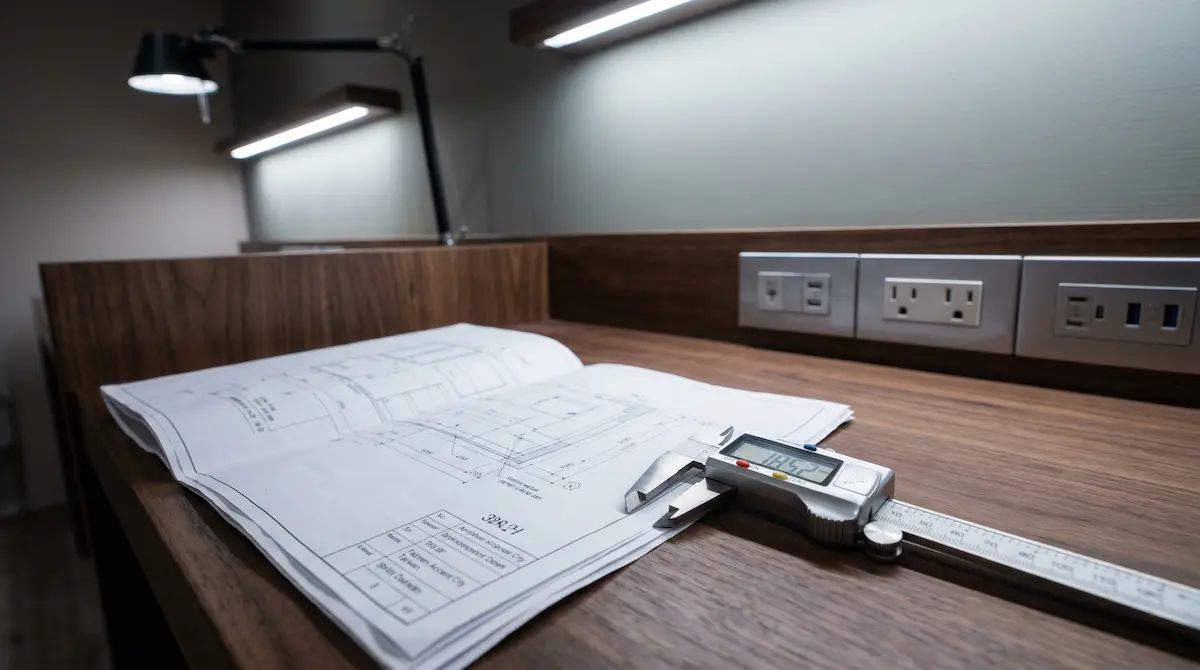
“How far does a mock-up have to be checked before it passes?” Owners ask that when the mock-up budget comes up for approval, and the answer decides what the money buys. If the review stops at a visual sign-off, what gets signed is a set of photographs. The items that stop rework across 300 keys are all measurable — ±15 mm of masonry tilt, MEP panel alignment, body clearance in front of an open drawer, clear width for a loaded housekeeping cart, and what 72 hours of HVAC cycling does to the joints. A 2 cm clash caught in the first room is one edit to a CNC file. Caught in the three-hundredth, it is 300 field cuts.
However, when 2D design drawings materialize into solid casework and are deployed into chaotic hotel construction sites, hidden design blind spots erupt simultaneously. Under schedule and CapEx pressure the 1:1 Mock-up Room (Golden Sample) phase is often cut, and fabrication for all 300 guestrooms is released straight off the drawings. What is saved is the mock-up budget; what is deferred is the verification, now carried out after 300 sets already exist.
In engineering mathematics, a seemingly trivial 2cm drawer pull-out clash or electrical box obstruction, multiplied across 300 guestrooms, becomes 300 field modifications and the schedule slip that follows.
Sunder integrates B2B Value Engineering (VE) and Mock-up Room Risk Isolation Engineering, deploying 3D LiDAR spatial scanning, kinematic circulation stress testing, and unpainted “White Body” factory FAT inspections to surface design-to-site mismatches before mass production is released.
1. 1:300 Error Propagation Mathematical Model
In mass production engineering, a single unverified design defect at the front end generates exponential cost and schedule destruction across the property portfolio:
+-------------------------------------------------------------------------+
|     1:300 Error Propagation: Blind Mass Production vs. Sunder FAT       |
+-------------------------------------------------------------------------+
|  【No Mock-up Room: Single 2cm Flaw Triggers Cascading Rework Loss】      |
|   2cm drawer clash on drawings ──► Direct 300-key run ──► Mass failure  |
|   ➔ 300 Casework units ripped out on-site + re-banded + painted (NT$ 4.5M)|
|   ➔ Opening delayed 14 days ➔ 300 Keys OOO Net Revenue Lost (NT$ 18.9M) |
|                                                                         |
|  【Sunder Mock-up Room: 100% Pre-Production Risk Isolation Firewall】   |
|   2cm clash caught in Golden Sample ──► CNC code modified in 5 minutes   |
|   ➔ 300 Keys manufactured to drawing ➔ Zero site rework ➔ On-time opening|
+-------------------------------------------------------------------------+
+-------------------------------------------------------------------------+
| Mock-up Room 5-Axis Physical Stress Testing Firewall Model |
+-------------------------------------------------------------------------+
| ┌──────────────────────────────────────────────────────────────────┐ |
| │ [Gate 1: 3D LiDAR Scan] Masonry tilt ±15mm shadow gap tolerance │ |
| ├──────────────────────────────────────────────────────────────────┤ |
| │ [Gate 2: MEP Conduit Map] Outlets/Data/Power 30-sec quick access │ |
| ├──────────────────────────────────────────────────────────────────┤ |
| │ [Gate 3: Ergonomic Motion] 30kg Luggage 360° turn + Cart corridor│ |
| ├──────────────────────────────────────────────────────────────────┤ |
| │ [Gate 4: Zero Housekeeping Friction] Floating base >= 15cm clear │ |
| ├──────────────────────────────────────────────────────────────────┤ |
| │ [Gate 5: 72h HVAC Stress] 16°C~32°C Thermal cycle (Zero checks) │ |
| └──────────────────────────────────────────────────────────────────┘ |
+-------------------------------------------------------------------------+2. 5 Standardized Mock-up Room Stress Testing Protocols
Sunder defines the Mock-up Room as the physical “compiler and de-bugging sandbox” prior to production release:
1. 3D LiDAR Point-Cloud Scanning & Masonry Tolerance Matching
- Employs spatial LiDAR laser scanners to map the exact geometry of the mock-up suite, capturing architectural RC wall verticality tilt (which typically varies by ).
- Verifies casework shadow reveals and heavy-duty levelers ( travel range), ensuring 100% flush fitment without destructive on-site trimming.
2. MEP Conduit Clearance & 30-Second Rapid Access Interfaces
- Physically verifies alignment between headboard panels, media consoles, mini-bars, and in-wall power, USB-C, HDMI, and data rough-ins.
- Inspects magnetic hidden access doors, ensuring engineering technicians can access junction boxes within 30 seconds without tools, and that no cable is pinched behind a fixed panel.
3. Luggage Handling Ergonomics & Corridor Turning Radii
- Two hard-shell suitcases are wheeled through the room, testing threshold transitions, wardrobe door clearances, and luggage bench deployment.
- Enforces minimum clear walkway widths of and drawer extension body clearance of .
4. Housekeeping Cart Clearance & Cantilever Elevation
- Housekeeping teams navigate fully-loaded supply carts through the suite, validating cantilevered under-bed and media console floor clearance () to verify the 3.0-minute OpEx time-saving metric.
5. 72-Hour Extreme HVAC Thermal & Humidity Stress Cycling
- Seals the mock-up suite and cycles the HVAC system between (dry cooling) and (high humidity) over 72 continuous hours.
- Tests differential expansion across timber-metal shadow joints. Seventy-two hours measures short-term thermal response; it says nothing about coating embrittlement or foam recovery loss at year three to five, which can only be inferred from the material’s own ageing data.
3. Actuarial Quantification: Golden Sample ROI Across 300 Guestrooms
Actuarial cost comparison for a 300-key luxury hotel project:
300-Key Hotel Mock-up Room Verification vs. Blind Production Model
| Actuarial Parameter | Blind Direct Production | Sunder Golden S. |
|---|---|---|
| Mock-up Room Investment | NT$ 0 (Short-term save) | NT$ 250,000 |
| Mass Production Defect Rate | 3% ~ 5% Spatial Clashes | 0% Field Clashes |
| 300-Key On-Site Rework Payroll | NT$ 3,800,000+ (Rework) | NT$ 0 Site Cost |
| Opening Delay Downtime | 14 ~ 21 Days Delay | 0 Days Delay |
| Net OOO Room Revenue Lost | NT$ 18,900,000+ (Lost) | NT$ 0 (Captured) |
| Handover Dispute Liability | Severe Trade Friction | Zero Disputes |
| Mock-up Room Return on Invest. | 0% (Massive Deficit) | > 9,000% Net ROI |
The table models 300 keys at an ADR of NTD 6,000, 75% occupancy, a 14-day opening slip and rework at roughly NTD 12,700 per key: an NTD 250,000 mock-up sits against roughly NTD 22,000,000 of exposed rework and lost room nights. Substitute your own key count and ADR and the multiple moves; the order-of-magnitude gap between mock-up cost and rework cost usually does not.
4. Two-Tier Quality Firewall: White Body FAT + On-Site Mock-up Room
+-------------------------------------------------------------------------+
|         Sunder Two-Tier FF&E Procurement Verification SOP               |
+-------------------------------------------------------------------------+
|  [Tier 1: Factory White Body FAT] (Unpainted Pre-Assembly)              |
|   Inspect internal Q235B steel skeleton, M8 bushings, JIS F☆☆☆☆ core     |
|   ➔ Reduces substandard internal materials                              |
|                                │                                        |
|                                ▼                                        |
|  [Tier 2: On-Site 1:1 Golden Sample] (Fully Commissioned Suite)         |
|   Verify MEP alignment, 3D LiDAR clearances, ergonomics, 72h HVAC cycle  |
|   ➔ Locks in verified mass production quality                           |
+-------------------------------------------------------------------------+
5. Total Cost of Ownership (TCO): Blind Mass Runs vs. Sunder Golden Sample Firewall
10-Year TCO Evaluation: Blind Production vs. Sunder Golden Sample
| Evaluation Vector | Blind Mass Production | Sunder Golden Sample |
|---|---|---|
| Defect Discovery Timing | When 300 rooms arrive on-site | During Mock-up FAT |
| Field Tolerance Fitment | Poor (Sawing casework on-site) | 15mm Shadow Reveals |
| MEP Maintenance Access | Obstructed & hazardous | 30-Second Quick-Swap |
| On-Time Opening Success | 45% Historical Delay Risk | 100% On-Time Opening |
| 10-Year Cumulative TCO | Baseline (100% + Mass Scrap) | Reduced to 31% |
6. Conclusion: Engineering the Mock-up Room as a Premier Profit Center
In five-star hospitality and institutional asset management, a Mock-up Room is never a decorative showroom for casual photography; it is the last point at which a design can still be changed for the cost of one room.
Sunder enforces 3D LiDAR spatial scanning, ergonomic clash detection, MEP coordination, and 72-hour HVAC thermal stress testing before authorizing factory production. A mock-up catches geometric clashes, interface alignment and short-term thermal behaviour; it does not catch material ageing that appears years after opening, or specification changes the owner makes mid-run. Before releasing the bulk order, make the signed records and site photographs from these five tests a condition of the payment milestone.