In the rigorous practice of hotel asset management, it is incredibly common for procurement departments to sign off on the lowest quote, only to deeply regret it three years later when scrutinizing the operational reports. This occurs because conventional B2B procurement strategies treat furniture as a one-time Capital Expenditure (CapEx), fatally ignoring the relentless Operational Expenditures (OpEx) generated throughout the asset’s lifecycle.
To uncover the true price of commercial furniture, decision-makers must implement the Total Cost of Ownership (TCO) calculation model. The core financial formula is:
TCO = Initial Cost + Maintenance Cost + Downtime Cost - Residual Value
In this brutal equation, the factor that ultimately dictates the hotel’s net profitability is the frequently overlooked, yet devastating, “Downtime Cost.”
The Cold Mathematics of Downtime
In the hospitality industry, time equates directly to inventory, and inventory equates to revenue. Every single day a room cannot be listed for sale represents an absolute cash flow hemorrhage.
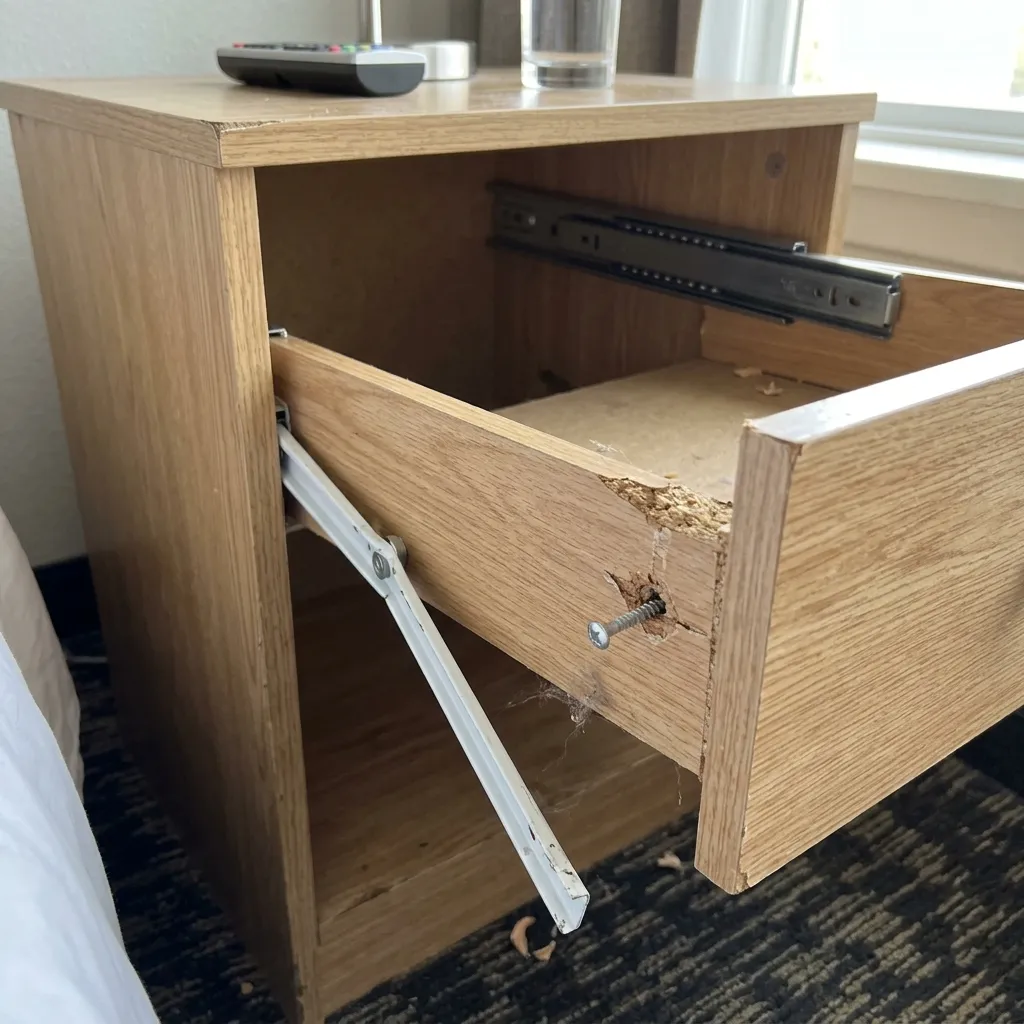
Let’s conduct a specific mathematical deduction: Assume that in a premium hotel market, the Average Daily Rate (ADR) for a standard business room is NT$ 3,000. If a cheap bedside table’s drawer slide breaks, or its substrate molds because it failed the strict Taiwan moisture defense standard requiring a mandatory replacement, the entire maintenance cycle could stretch to an agonizing 7 days.
The Downtime Cost for these 7 days amounts to an astonishing NT$ 21,000. This hidden loss is often already more than double the original purchase price of that conventional bedside table. When this probability is multiplied by the scale of a hotel with hundreds of rooms, the systemic downtime losses triggered by cheap furniture morph into a massive financial black hole, relentlessly eroding the annual net profit margins.

The 5 to 10-Year TCO Calculation Matrix
If we aggressively extend the timeline to a 5 to 10-year operational cycle, the financial curves of conventional cheap products versus high-durability specification products will exhibit a dramatic golden crossover.
Starting in the 3rd year of operation, as materials inevitably degrade and cheap hardware fatigues, the maintenance and downtime costs for conventional furniture rise exponentially. Conversely, through Sunder’s Value Engineering (VE), we configure high-abrasion High-Pressure Laminates (HPL) and premium industrial hardware for owners. The primary intent of this design is not purely aesthetic; it is deeply rooted in a physical defense logic aimed at maximizing housekeeping efficiency and fortifying the furniture’s damage resistance.
Within the Total Cost of Ownership (TCO) calculation matrix, while such high-durability specifications slightly increase the initial quote, they violently compress the future “Maintenance Cost” and “Downtime Cost” to near zero. Ensuring that the hotel’s “Available Room Nights” are maximized without interruption is the ultimate financial solution from a professional asset management perspective.
Treating Furniture as High-Yield Revenue-Generating Equipment
In the construction logic of commercial spaces, furniture is never a disposable consumable; it is “revenue-generating equipment” that directly dictates operational efficiency and room yield.
Owners and procurement executives must definitively abandon evaluating quotes with a “buying consumables” mindset, and instead scrutinize suppliers with the rigorous financial standards applied to “investing in high-utilization equipment.” Establishing a robust procurement framework centered entirely around Total Cost of Ownership (TCO) is the only definitive financial strategy to ensure a hotel maintains high profitability and unshakeable competitiveness over a long operational lifecycle.
Technical Glossary
- TCO (Total Cost of Ownership): Encompasses not just the initial purchase price (CAPEX), but also the hidden operational costs (OPEX) including installation, maintenance, cleaning, and eventual replacement. Sunder minimizes TCO through extreme engineering.
- FF&E (Furniture, Fixtures & Equipment): All movable furniture and equipment within hospitality and commercial projects. We focus on the durability and asset lifecycle management of FF&E.
- VE (Value Engineering): Achieving the optimal cost-benefit ratio through process optimization and material substitution without sacrificing design aesthetics or structural integrity.