In the rigorous development of hotel assets, “undisturbed sleep” is the single, non-negotiable core deliverable. However, in practical B2B procurement strategies, budgets often skew excessively toward visual aesthetics and tactile upgrades, completely ignoring the most lethal vulnerability: auditory defects. A sharp friction noise from a bed frame when a guest turns at night, or the booming slam of a wardrobe door, can instantly destroy the brand trust built by a multi-million dollar renovation.
The traditional procurement habit of treating furniture as a disposable commodity is a systemic financial error that actively generates guest complaints. True asset management requires viewing acoustic control through the lens of Total Cost of Ownership (TCO), treating it as a physical defense engineering project designed to seal the financial bleeding points and prevent revenue leakage.
Kinetic Energy Release and Direct Offsets of Guest Refunds
The physical essence of abnormal furniture noise is the “micro-displacement and friction” generated when materials are subjected to dynamic stress.
When a conventional bed frame endures dynamic loads, if there is even a microscopic tolerance at the hardware locking points, the unisolated hard contact translates directly into piercing high-frequency noise. Additionally, cabinet doors lacking proper damping designs transfer their kinetic energy straight into the wall structure upon closing, creating low-frequency structural noise that effortlessly penetrates soundproof walls.
In an era where online reviews dictate occupancy rates, a single negative review about a “squeaky bed” or the hidden cost of front-desk refunds and room upgrades due to nighttime noise often exceeds the manufacturing cost of the furniture itself.
Isolating Friction and Heavy-Duty Damping Mechanisms
Through precise Value Engineering (VE), Sunder eliminates the physical trigger directly from the manufacturing source, optimizing the project’s Capital Expenditure (CapEx):
- Bed Frame Load Isolation: We deploy high-carbon steel embedded components to ensure absolutely zero-tolerance locking, alongside high-density acoustic isolation pads, decisively severing the transmission path of friction noise at the molecular level.
- Heavy-Duty Hydraulic Damping Hardware: Upgrading to industrial-grade multi-stage hydraulic dampers transforms the violent physical impact of a closing door into a silent, uniform closure. This forcibly suppresses instantaneous noise spikes to below the 20-decibel background ambient noise level.
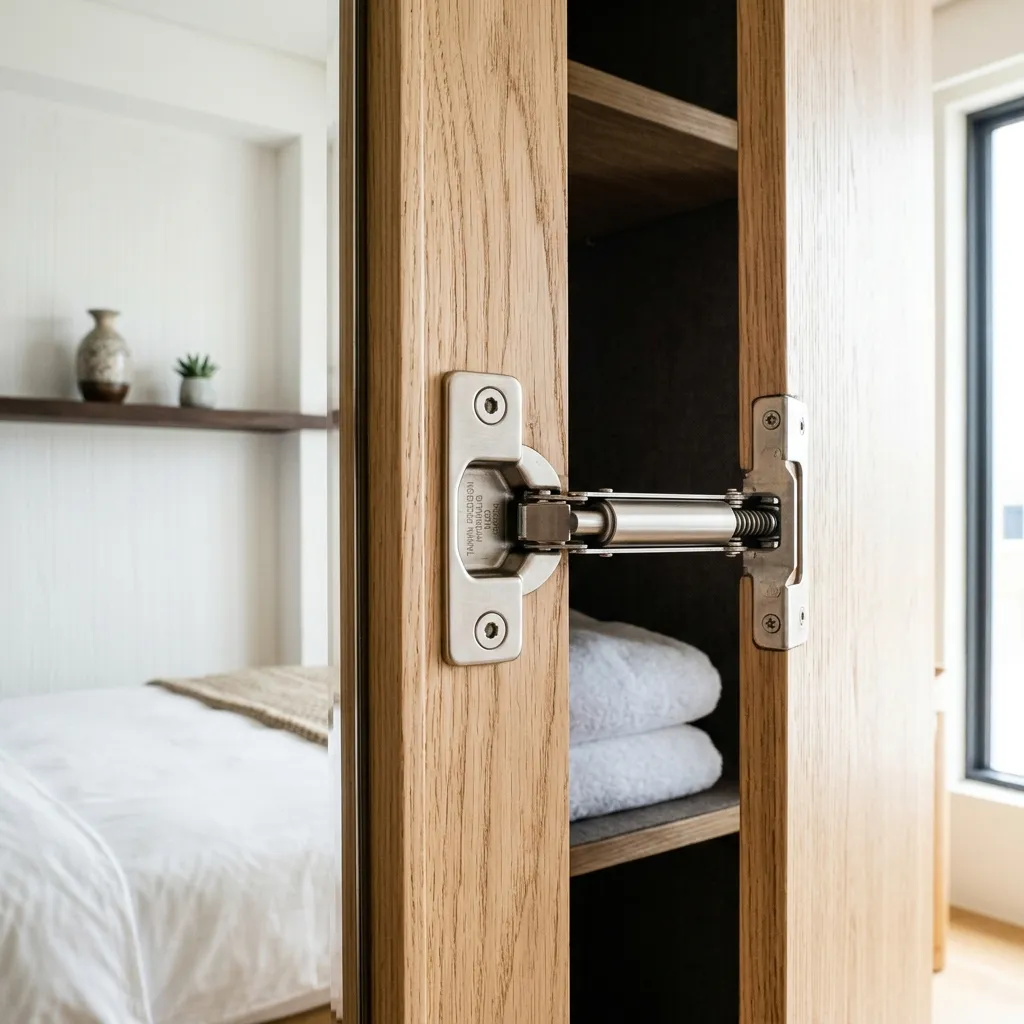
The Chain Reaction of Acoustic Control, Moisture Defense, and Cleaning Efficiency
Under extreme operational testing, superior silencing engineering is never an isolated feature.
When executing advanced acoustic modular decoupling, this high-tolerance, enclosed structural design not only blocks noise transmission but triggers powerful operational chain reactions:
- Extreme Climate Defense: Precise hardware joints and flawless edge banding effectively block moisture intrusion, achieving the strict Taiwan moisture defense standard and preventing structural noise caused by substrate expansion and deformation.
- Operational Friction Optimization: The flat, zero-tolerance surfaces and suspended modular designs physically eradicate cleaning dead corners. This directly boosts housekeeping efficiency, aggressively lowering the hidden Operational Expenditure (OpEx) of manual labor.
Within the Total Cost of Ownership (TCO) matrix, the initial Capital Expenditure (CapEx) for hardware upgrades is essentially the purchase of a long-term “guest complaint insurance policy.” Ensuring that hardware remains absolutely silent and highly operational under extreme usage is the only definitive solution for defending long-term profitability and asset value.
Technical Glossary
- TCO (Total Cost of Ownership): Encompasses not just the initial purchase price (CAPEX), but also the hidden operational costs (OPEX) including installation, maintenance, cleaning, and eventual replacement. Sunder minimizes TCO through extreme engineering.
- FF&E (Furniture, Fixtures & Equipment): All movable furniture and equipment within hospitality and commercial projects. We focus on the durability and asset lifecycle management of FF&E.
- VE (Value Engineering): Achieving the optimal cost-benefit ratio through process optimization and material substitution without sacrificing design aesthetics or structural integrity.