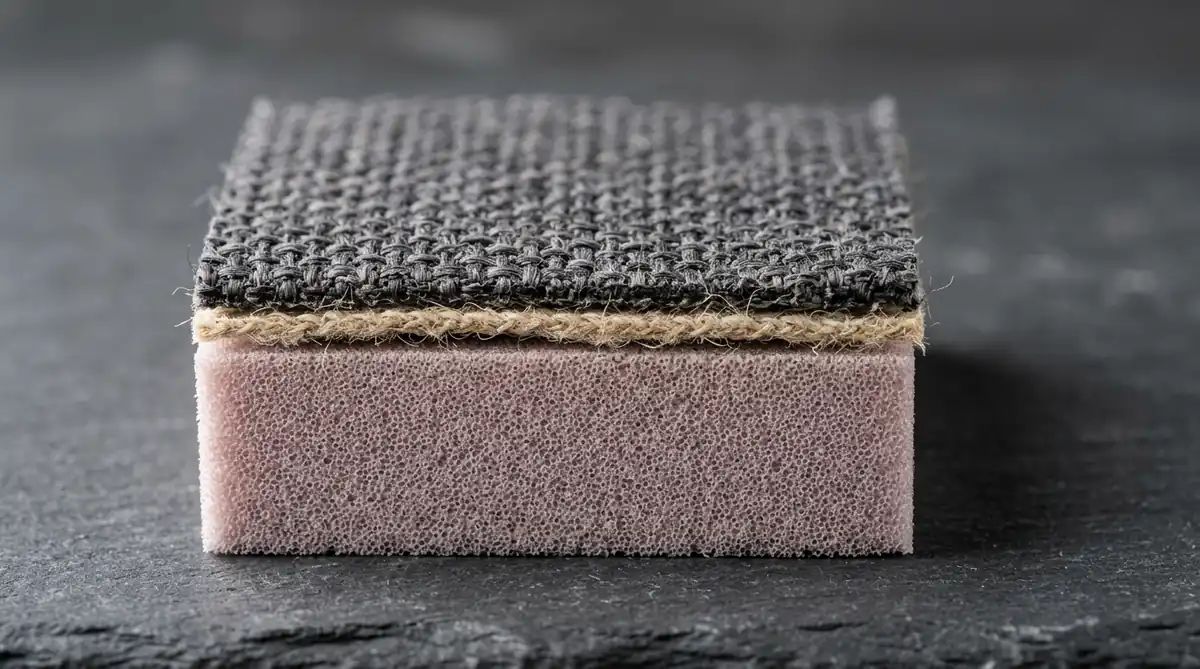
Somewhere in every FF&E submittal review, someone has to decide whether the fire documentation in front of them is sufficient. The report is usually genuine — a fabric tested to EN 1021-1 and EN 1021-2 by an accredited lab. What BS 7176 Medium Hazard asks for is different: the fabric, the FR interliner and the foam tested together as the finished composite, against the BS 5852 Source 5 wooden crib. Accepting the first document in place of the second is the most common way a property arrives at pre-opening inspection with furniture it cannot certify.
In conventional FF&E procurement, developers and design teams seeking to lower initial bids often misapply residential-grade fabrics or rely on inexpensive “chemical post-treatment back-coatings.” In humid subtropical climates combined with commercial housekeeping laundering, chemical coatings hydrolyze and wash out within 6 months. When municipal fire marshals conduct destructive ignition sampling during pre-opening audits, failing test results trigger inspection rejections, mandatory closure orders, or license revocations, while each day of delay accrues interest and fixed payroll against no room revenue.
The clauses below track the BS 7176 Medium Hazard (Crib 5) standard and commercial compliance workflows through B2B Value Engineering (VE) and systemic physical fire-barrier engineering.
1. International Fire-Retardant Standards: BS 7176 & BS 5852 Hazard Classifications
British Standard BS 7176 (Specification for resistance to ignition of upholstered furniture) is the universally mandated benchmark recognized by premier international hotel operators (Marriott, Hilton, IHG, Hyatt):
+-------------------------------------------------------------------------+
|             BS 7176 Commercial Furniture 3 Hazard Classifications       |
+-------------------------------------------------------------------------+
|  [Low Hazard]                                                           |
|   Applications: Residential apartments, low-density private offices     |
|   Testing Scope: EN 1021-1 (Smoldering Cigarette) + EN 1021-2 (Match)   |
|                                                                         |
|  [Medium Hazard (Mandatory 5-Star Hotel Benchmark)]                     |
|   Applications: Guestrooms, hotel lobbies, restaurants, ballrooms       |
|   Testing Scope: EN 1021-1/2 + BS 5852 Source 5 (Crib 5 Ignition Test)  |
|                                                                         |
|  [High Hazard]                                                          |
|   Applications: Hospital psychiatric wards, prison facilities, casinos  |
|   Testing Scope: BS 5852 Source 7 (Severe Wooden Crib Ignition Source)  |
+-------------------------------------------------------------------------+
+-------------------------------------------------------------------------+
| BS 5852 Source 5 (Crib 5) Ignition Test Physical Model |
+-------------------------------------------------------------------------+
| |
| [ Wooden Pine Crib (Crib 5, 17g) ] |
| ┌────────────────────────────────────────┐ |
| │ 5-Tier Pinewood + 1.4ml Isopropanol │ ──► 5.2 kW Heat |
| └───────────────────┬────────────────────┘ Release Rate |
| │ (Ignited for 10 min) |
| ┌─────────────────────────▼─────────────────────────┐ |
| │ [BS 7176 Medium Hazard Passing Criteria] │ |
| │ 1. Flaming must self-extinguish within 10 minutes │ |
| │ 2. No progressive smoldering (< 60 minutes) │ |
| │ 3. Char damage length <= 100mm (No burn-through) │ |
| └───────────────────────────────────────────────────┘ |
+-------------------------------------------------------------------------+The reason international 5-star hotels enforce Crib 5 is that simple cigarette or match tests only simulate minor thermal sources, whereas Crib 5 simulates intense localized heat surges (equivalent to a instantaneous heat release from a burning wastebasket), which is the load the furniture has to survive without sustaining the fire itself.
2. Sunder 4-Tier Fire Barrier System Architecture
True compliance with BS 7176 Medium Hazard requires a fully integrated composite assembly, not merely a treated surface textile:
+-------------------------------------------------------------------------+
|     Sunder Commercial Upholstery 4-Tier Fire Barrier Cross-Section      |
+-------------------------------------------------------------------------+
|  [Layer 1: Surface Textile] Inherent FR Yarn Fabric (Trevira CS / Leather)
|                                │                                        |
|  [Layer 2: Fire Barrier]    150g/m² Aramid / Fiberglass FR Interliner   |
|                                │                                        |
|  [Layer 3: Core Foam]       CMHR Combustion Modified Foam (>= 45 kg/m³) |
|                                │                                        |
|  [Layer 4: Structural Seam] Kevlar High-Temperature Thread (>= 380°C)   |
+-------------------------------------------------------------------------+
1. Inherent Flame-Retardant Yarns (Trevira CS / Flame-Retardant Leathers)
- Organophosphorus flame-retardant molecules are permanently polymerized directly into the polyester fiber molecular chain (not applied as a topical wash). Retested after 50 commercial dry-cleaning cycles, FR performance still meets the original certified level.
- When exposed to flame, fibers instantly char into a dense oxygen-depriving crust. The Limiting Oxygen Index (, well above ambient oxygen concentration of ) supports self-extinguishment once the ignition source is removed, without the hydrogen cyanide (HCN) release or heavy soot loading seen in some coated alternatives.
2. High-Performance FR Interliner Barrier
- A non-woven aramid/fiberglass barrier layer is inserted between the upholstery fabric and internal foam cores, thermal-insulating the foam core to prevent plastic melt-dripping.
3. Core Cushioning: CMHR Combustion-Modified High-Resilience Foam
- Utilizes CMHR (Combustion Modified High Resilience) cold-cured foam infused with micro-encapsulated melamine and ammonium polyphosphate.
- Density is strictly maintained at , ensuring ergonomic seating support while passing BS 5852 Crib 5 tests without fire propagation.
3. Inherent FR Yarns vs. Chemical Back-Coating: Technical Comparison
Inherent FR Yarns vs. Chemical Back-Coating Comparison Matrix
| Technical Metric | Chemical Back-Coating | Inherent FR Yarn |
|---|---|---|
| FR Mechanism | Brominated chemical coating | Molecule chain bound |
| Climate Resistance | Hydrolyzes in humid air | 100% Hydrolysis-proof |
| Laundering Durability | Fails after 5-10 washes | 50+ Cycles (0% Loss) |
| Toxicity & Smoke | Toxic halogenated smoke | Minimal water vapor |
| Hand-Feel & Breath | Stiff, plasticized backing | Soft, breathable drape |
| 10-Year Risk Profile | Failed inspections, fines | 100% Audit Compliance |
4. Fire Marshall Inspection Compliance & Verification Traceability SOP
To ensure properties pass municipal fire department inspections smoothly:
+-------------------------------------------------------------------------+
|              Commercial Fire Compliance Verification Roadmap            |
+-------------------------------------------------------------------------+
|  [Step 1: Certified Lab Tests] --> Submit textiles & foam to accredited  |
|                                    laboratories (BS 7176 / CNS 13590)   |
|                                │                                        |
|  [Step 2: Permanent FR Labels] --> Stitch indelible, non-removable FR   |
|                                    compliance labels to furniture bases |
|                                │                                        |
|  [Step 3: Test Certificate ID] --> Print test numbers, wash durability, |
|                                    and manufacturer credentials on label|
|                                │                                        |
|  [Step 4: Compliance Dossier]  --> Deliver complete certified test      |
|                                    reports and supply chain traceability|
+-------------------------------------------------------------------------+
5. Total Cost of Ownership (TCO): Substandard Back-Coating vs. Sunder Systemic FR
10-Year TCO Comparison: Cheap Back-Coating vs. Sunder Systemic FR
| Evaluation Vector | Chemical Back-Coating | Sunder Systemic FR |
|---|---|---|
| Initial Bid Price | Appears 15% cheaper | Standard Competitive |
| Fire Audit Pass Rate | 30% ~ 50% (High risk) | 100% First-Time Pass |
| Inspection Delay Losses | 300 / room / day | Zero Opening Delays |
| Re-Treatment Costs | Re-spray every 2-3 years | $0 Re-treatment Fee |
| Liability Risk | High risk of catastrophe | Maximum Public Safety |
| 10-Year Cumulative TCO | Baseline (100% + Penalties) | Reduced to 32% |
6. Conclusion: Three Documents to Check Before You Sign
In luxury hotel asset management, fire safety compliance is a non-negotiable bottom line. Two armchairs may look identical on the showroom floor, but whether the interior core acts as flammable kindling or self-extinguishes under a Crib 5 inferno is the difference an inspector is looking for when they take a destructive sample.
Sunder enforces Trevira CS inherent FR yarns, CMHR molded foam, and Kevlar stitching across all commercial upholstery. One limit is worth stating: this scope covers upholstered loose furniture. Fixed millwork, drapery and carpet carry separate flammability submissions under separate contractors, and a BS 7176 certificate on a sofa does not transfer to them. Within that scope, certified testing and documented assembly records protect our clients’ operational longevity and long-term brand equity.