In the boardrooms of multinational hotel groups and large hotel chains, ESG is no longer merely a decorative public relations slogan; it is a hard financial metric that directly dictates corporate financing rates and supply chain survival rights.
However, when addressing sustainability mandates, many B2B procurement strategies fall into the perilous trap of “material greenwashing.” Procuring cheap furniture that boasts eco-friendly labels but possesses dangerously fragile physical structures results in mandatory scrappage by the second year of operation due to delaminated hardware or catastrophic structural fracturing. In terms of actual resource consumption, the repetitive manufacturing, cross-border ocean freight, and landfilling generated by these short lifespans create a Scope 3 carbon footprint that vastly eclipses the initial, theoretical environmental benefits of the raw materials.
True sustainability is an uncompromising physical defense engineering effort aimed at “resisting natural equipment aging.” Extreme physical durability and repairability are the most prominent, effective, and financially sound carbon reduction strategies.
The Carbon Emission Black Hole and Brand Crisis of “Disposable Eco-Friendliness”
Supply chains built entirely on low-price competition possess a parasitic profit model reliant upon “high-frequency damage and replacement.”
When a large hotel group procures conventional furniture with a lifecycle of merely two years to minimize Capital Expenditure (CapEx), they are essentially planting a ticking time bomb on their operational balance sheet. This signifies not only continuous financial hemorrhaging from maintenance and Operational Expenditure (OpEx) during operations but, more severely, when in-room hardware collapses or emits pungent odors, it irreparably damages the “brand trust” that the group spent hundreds of millions to establish.
Placing this high-attrition rate into the rigorous trials of Taiwan moisture defense, the premature retirement of eco-friendly materials due to rapid moisture absorption occurs endlessly. In the social media era, the collapse of hardware quality instantly transforms into a viral public relations disaster—a catastrophic loss that no cheap initial procurement price can ever offset.
The ESG Defense Layer of Extreme Durability and Modular Decoupling
To achieve authentic ESG targets and aggressively drive down Total Cost of Ownership (TCO), the consumption logic of commercial furniture must be altered at its very core. Sunder’s Value Engineering (VE) constructs two robust sustainable defense layers for large hotel groups:
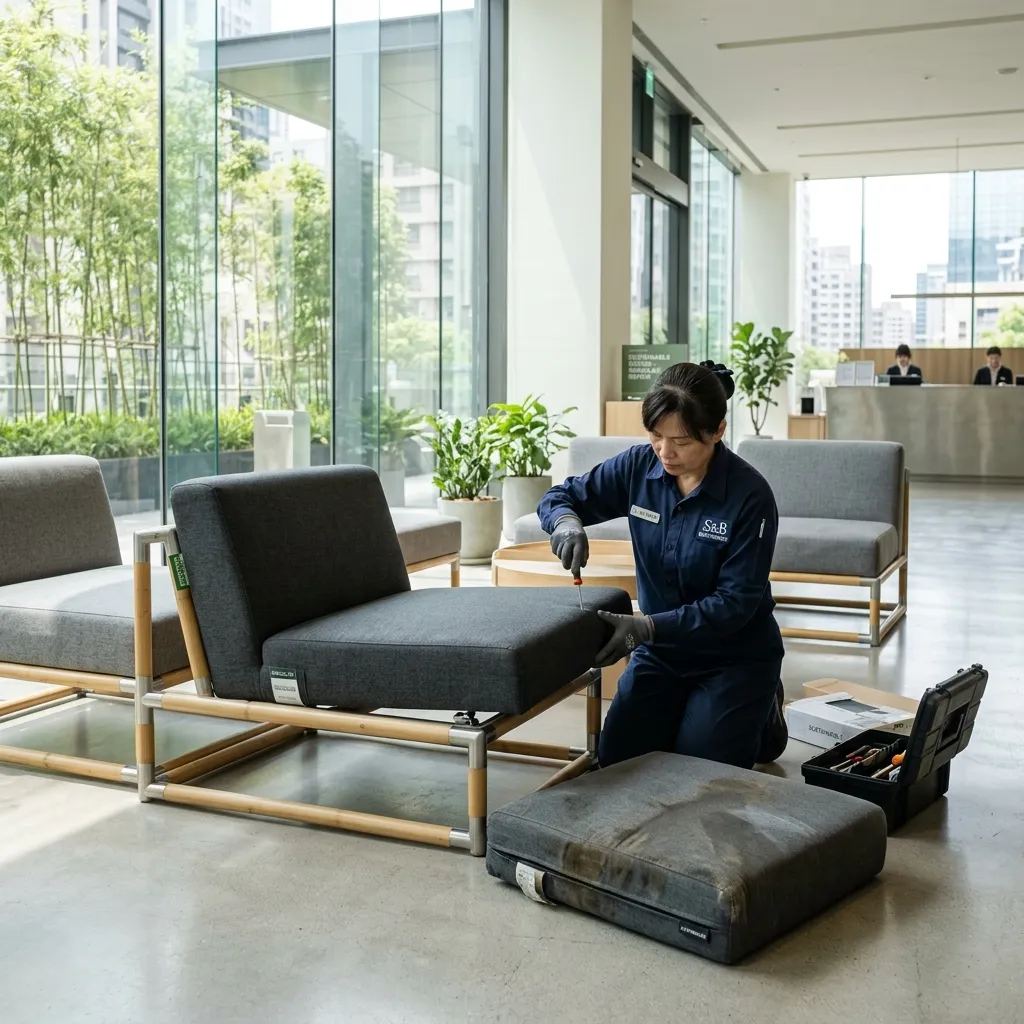
- Physical Modular Decoupling: Separating the high-attrition impact zones of the furniture (such as seat cushions and tabletops) from the core load-bearing skeleton through precise physical engineering processes. When localized fabrics or surfaces are damaged, only a modular component representing less than 10% of the total volume needs replacing. This not only forcefully extends the furniture’s lifecycle beyond 10 years, but seamless modules also eradicate cleaning dead corners, drastically boosting housekeeping efficiency.
- Material Traceability and Chemical Compliance: Comprehensively utilizing low-formaldehyde, moisture-resistant, and anti-warp legally traceable boards. Every batch of structural components leaving the factory possesses a clear, auditable track record, rendering the supply chain black box entirely transparent and providing authentic data verifiable by third-party organizations (such as LEED or WELL).
Transforming Defensive Procurement into High-Yield Sustainable Capital
For large, premium hotel chains, guest trust originates fundamentally from the high stability and predictability of hardware facilities.
Through intertemporal dynamic calculation, initially investing in highly durable, highly compliant modular furniture is essentially a strategic defensive deployment. On a micro level, it ruthlessly suppresses the financial black hole of operational maintenance; on a macro level, it provides the hotel group with credible, auditable ESG carbon reduction data, thereby attracting premium green capital investment. True defensive procurement not only massively reduces operational friction but definitively transforms hardware into a sustainable moat that fiercely defends brand value.
Technical Glossary
- TCO (Total Cost of Ownership): Encompasses not just the initial purchase price (CAPEX), but also the hidden operational costs (OPEX) including installation, maintenance, cleaning, and eventual replacement. Sunder minimizes TCO through extreme engineering.
- FF&E (Furniture, Fixtures & Equipment): All movable furniture and equipment within hospitality and commercial projects. We focus on the durability and asset lifecycle management of FF&E.
- VE (Value Engineering): Achieving the optimal cost-benefit ratio through process optimization and material substitution without sacrificing design aesthetics or structural integrity.