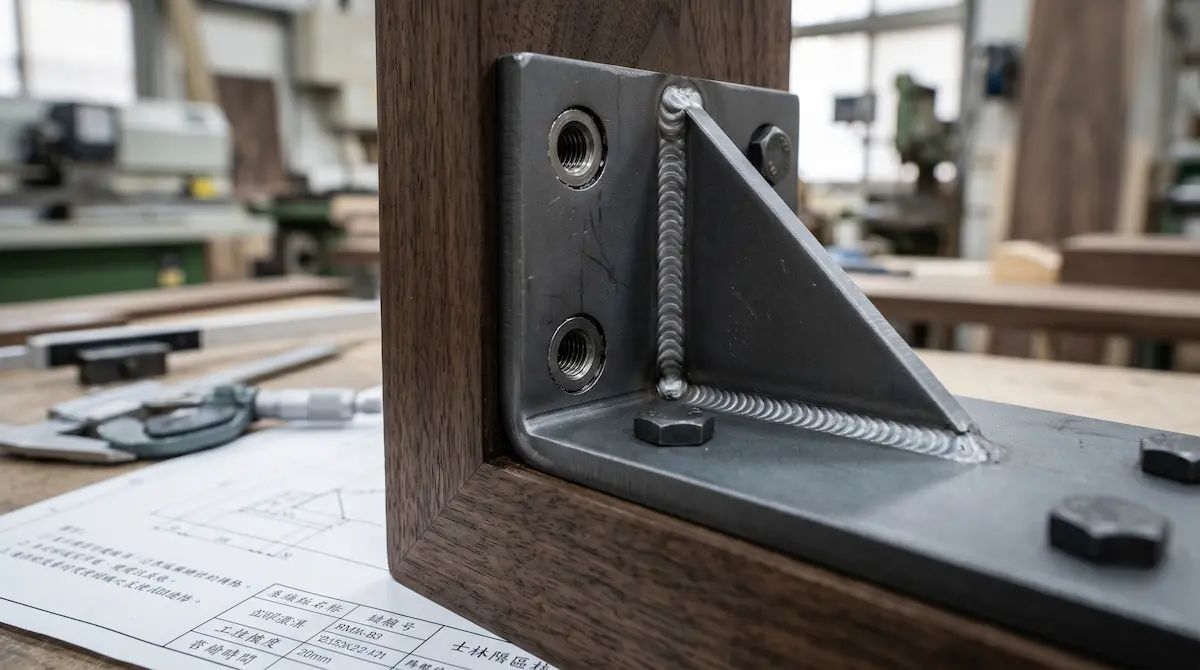
Frame joinery comes down to two defensible routes: a fully welded one-piece steel frame, or a knock-down frame bolted into embedded steel bushings. The welded frame spreads load along a 360° bead and can hold joint stress near 35 MPa, but it ships bulky, costs more per container and cannot be repaired on site; the bolted frame ships flat and can be re-torqued, at the price of funnelling every load into a few square centimetres around the fixing. What separates them is not whether there is a weld, but two numbers: root penetration as a percentage of base metal wall thickness, and single-point pull-out capacity in kN. ANSI/BIFMA X5.1 and X5.4 cyclic testing exists to show how much of each is left after 100,000 cycles.
Residential furniture operates under “single-occupant, low-frequency (annual average cycles), predictable static loads”; conversely, hotel commercial furniture must withstand dozens of varying occupant body types daily, heavy luggage collisions, single-sided eccentric seating, and unpredictable dynamic impact shocks (annual average cycles). When procurement teams specify residential-grade spot-welding or direct wood screws into soft timber, joinery reaches its Fatigue Limit within 6 to 12 months. Micro-cracks propagate through weld beads, screws strip, and chair legs fail in service, which becomes a guest injury liability.
Sunder integrates B2B Value Engineering (VE) and Fracture Mechanics into manufacturing standards through S-N curve stress dispersion, TIG continuous full-penetration welding, and ANSI/BIFMA 100,000-cycle dynamic testing, so joint life is stated as a number a third party can re-run.
1. S-N Wöhler Fatigue Curve & Miner’s Cumulative Damage Rule
Under continuous cyclic stress, material failure occurs not at static yield strength limits, but through the microscopic accumulation and propagation of fatigue cracks:
Where represents applied cycles at stress amplitude , and represents the cycles-to-failure fatigue limit at that stress level.
+-------------------------------------------------------------------------+
|                  S-N Wöhler Fatigue Life Curve (Stress vs. Cycles)      |
+-------------------------------------------------------------------------+
|  Cyclic Stress Amplitude σ (MPa)                                        |
|    ▲                                                                    |
| 300│ [Spot-Welded Joints] ──► Severe stress concentration (Fails at 5k) |
|    │       \                                                            |
| 200│        \                                                           |
|    │         \                                                          |
| 100│          \   [Sunder TIG Full-Penetration + Bushings]              |
|    │           \════════════════════════════════ (Infinite Fatigue Life)|
|   0└────────────────────────────────────────────────────────► Cycles (N)|
|         10^3 (Residential)         10^4                     10^5 (Commercial)
+-------------------------------------------------------------------------+
+-------------------------------------------------------------------------+
| Point Stress Concentration vs. Sunder 3D Stress Dispersion |
+-------------------------------------------------------------------------+
| 【Conventional Spot Weld / Direct Screw (Localized Point Stress)】 |
| External Load F ──► Concentrated on 2mm² weld ──► Stress > 250 MPa |
| --> Rapid fatigue tearing and joint shear rupture |
| |
| 【Sunder Continuous Weld / Carbon Bushings (Uniform 3D Dispersion)】 |
| External Load F ──► Dispersed across 360° weld + Corner blocks |
| --> Stress uniformly diluted to <= 35 MPa |
+-------------------------------------------------------------------------+2. 4 Core Commercial Structural Reinforcement & Mechanical Joinery Methods
Spot welds fail by cracking at the nugget edge and propagating through the heat-affected zone; wood screws fail by elongating the hole as the fibre is worked. The four specifications below address those two mechanisms:
+-------------------------------------------------------------------------+
|     Sunder Structural Anti-Fatigue Cross-Section (Cross-Section)        |
+-------------------------------------------------------------------------+
|  [Layer 1: Hardwood Core]    E0 Multi-Ply Hardwood Core (Density >=700) |
|                                │                                        |
|  [Layer 2: Threaded Bushing] M8/M10 High-Carbon Steel Bushings (>=4.5kN)|
|                                │                                        |
|  [Layer 3: Continuous TIG]   Grade-304 / Q235B 360° TIG Full-Penetration|
|                                │                                        |
|  [Layer 4: Corner Blocks]    45° Solid Timber Corner Blocks + Poly Glue |
+-------------------------------------------------------------------------+
1. Metal Substructures: 360° Continuous TIG Full-Penetration Welding
- All metal bases, chair legs, and load-bearing crossbeams utilize continuous tungsten inert gas (TIG) welding with high-purity argon shielding, achieving weld root penetration across of base metal wall thickness.
- Post-weld stress-relief annealing and flush grinding conform to AWS D1.1 Level B structural standards, which lowers the chance of crack initiation at the weld toe from residual stress.
2. Timber-to-Metal Joinery: M8/M10 Hardened Steel Threaded Bushings
- Direct wood screw fastening into timber is strictly prohibited. Sunder CNC pre-bores all joinery locations, embedding M8/M10 case-hardened carbon steel internal/external threaded bushings.
- Converts weak wood-grain screw biting into machine-grade metal-to-metal bolted connections, delivering a single-point pull-out tensile capacity capable of thousands of re-assemblies without stripping.
3. Corner Joinery: 45° Double-Tenon Solid Hardwood Corner Blocks
- Sofa bases and dining chair perimeter frames incorporate double-tenon solid hardwood corner braces bonded with high-tensile modified polyurethane structural adhesives.
- Creates a triangular truss that takes the torsional shear generated by eccentric single-sided seating. This approach has a boundary: a fully welded frame cannot ship flat, which cuts 40 ft container yield by roughly a third and rules out field repair. For ballrooms and conference centres, where the same chair is stacked and moved daily, the knock-down bushed frame is usually the better call, with acceptance weighted toward pull-out capacity at the fixing.
3. ANSI/BIFMA Mechanical Strength & Cyclic Fatigue Proof Standards
All Sunder structural assemblies pass authoritative ANSI/BIFMA X5.1 (Office Seating) / X5.4 (Lounge & Public Seating) commercial tests:
ANSI/BIFMA Mechanical Strength & Cyclic Testing Matrix
| Inspection Vector | Test Conditions & Parameters | Sunder Passing Spec |
|---|---|---|
| Backrest Static | 136 kg (300 lbs) Proof Force | Zero Joint Fracture |
| Seating Impact | 102 kg Bag Drop from 150mm | 100,000 Cycles Rated |
| Leg Drop Impact | 10 Drops from 450mm Height | Zero Weld Cracking |
| Armrest Vertical | 100 kg Static Load per Side | Deflection <= 1.5mm |
| Drawer Slide Test | 35 kg Full Load Testing | 60,000 Silent Cycles |
4. Structural Fatigue, Climate Resilience & Public Liability Defense
In high-humidity subtropical climates, structural fatigue defense is intimately linked with moisture isolation:
- 6-Sided Hydrophobic Sealing: Perimeter board edges are sealed with waterproof PUR hot-melt adhesives, preventing moisture from infiltrating threaded bushing holes and loosening fasteners.
- Corrosion & Embrittlement Defense: All steel members undergo shot-blasting and electrostatic powder-coating, passing ASTM B117 1,000-hour salt spray testing, which reduces the oxidation-driven loss of section that precedes stress embrittlement.
5. Total Cost of Ownership (TCO): Residential Craft vs. Sunder Heavy-Duty Engineering
10-Year TCO Evaluation: Residential Low-Spec vs. Sunder Heavy-Duty
| Evaluation Vector | Residential Low-Spec | Sunder Heavy-Duty |
|---|---|---|
| Welding Method | Spot welding (Fatigue snap) | 360° TIG Full-Pen. |
| Fastener Mechanism | Direct wood screws (Stripped) | M8 Steel Bushings |
| BIFMA Cyclic Rating | 5,000 ~ 10,000 Cycles | 100,000 Cyclic Rate |
| Structural Failure Risk | High (Guest injury claims) | 0 Structural Claims |
| FF&E Replacement Cycle | 2 to 3 Years (Forced Scrap) | 10+ Year Asset Life |
| 10-Year Cumulative TCO | Baseline (100% + Liability) | Reduced to 32% |
6. Conclusion: State Joint Life as a Number Someone Can Re-Run
In five-star hospitality operations, structural safety is the non-negotiable bottom line of risk management. An elegant lounge chair that collapses under an occupant creates legal liability and reputational damage that outweigh the procurement saving that produced it.
Sunder standardizes fatigue fracture mechanics, continuous TIG full-penetration welding, hardened steel bushings, and BIFMA 100,000-cycle proof testing directly into manufacturing workflows. Two documents are worth requesting at bid stage: the weld root penetration and AWS D1.1 grade record, and the ANSI/BIFMA X5.1 or X5.4 cyclic test report for the specific model. Without both, joint grade is not something either side can argue from.