Executive Summary
Technical specifications for home spa FF&E, addressing high humidity, material durability, and CapEx life-cycle optimization.
Spatial Philosophy & Architectural Narrative
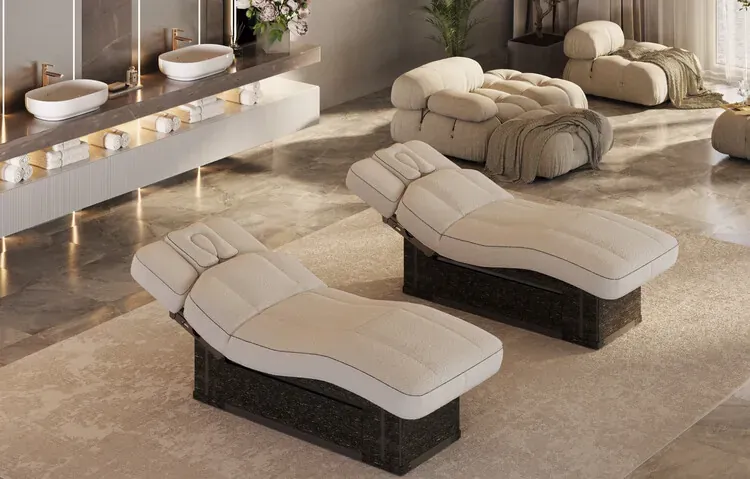
Modern residential designs increasingly incorporate wellness and spa functionalities, blurring the line between hospitality resorts and high-end private residences. Equipment such as specialized massage beds and relaxation loungers must integrate seamlessly with architectural layouts, ambient lighting, and high-humidity environmental controls. Spatial hierarchy requires clean circulation paths that accommodate both user mobility and service staff operations. Ambient lighting design often utilizes moisture-sealed embedded LED strips operating at IP65 or higher ratings to maintain acoustic and visual tranquility without compromising safety. From a B2B development perspective, spa FF&E integration demands precise interface management between fixed millwork, plumbing systems, and electrical infrastructure. Architectural narratives in wellness environments focus on natural tactile experiences, employing low-VOC wood finishes, non-porous natural stone, and tailored upholstery. Achieving balance between sensory calm and functional resilience ensures long-term operational viability for both luxury hospitality properties and ultra-luxury residential developments.
Luxury FF&E Material Engineering & Joinery Breakdown
Spa furniture and millwork operate under continuous high-humidity conditions (75-85% RH), necessitating stringent material engineering and joinery specifications. Plywood substrates must meet F1 grade low-formaldehyde and moisture-resistant standards (CNS 1349 / EN 314-2 Class 3 exterior), with a 24-hour water absorption thickness swelling rate below 3%. Joinery employs precision mortise and tenon structures supplemented with moisture-curing polyurethane (PU) structural adhesives to prevent seam delamination. Mechanical hardware, including hinges and drawer slides, must be fabricated from SUS304 or SUS316 stainless steel, passing a 96-hour neutral salt spray test (ASTM B117) without red rust, and certified for 100,000 fatigue cycles under dynamic loading up to 45 kg. Metal trims feature PVD (Physical Vapor Deposition) titanium coating over stainless steel, with film thickness exceeding 0.3 μm and Vickers hardness above HV 800 to resist oxidation from essential oils and cleaning agents. Stone counter surfaces require glass fiber backing mesh (200 g/m²) and six-sided silane penetrant sealing, maintaining water absorption below 0.15% per ASTM C97. Upholstery fabrics used on massage beds and loungers must exceed 50,000 Martindale cycles (ISO 12947-2) and pass BS 7176 Medium Hazard (Crib 5 ignition source, peak heat release 5.2 kW) flame retardancy standards.
Hospitality Operations, Wear Analysis & TCO Model
Spa amenities and custom millwork face severe mechanical and chemical wear from high-frequency guest use, massage oils, and ambient humidity. In a luxury hospitality property with 100 keys and spa facilities, utilizing standard moisture-resistant particleboard and conventional polyurethane coatings typically leads to material swelling and upholstery cracking within 18 to 24 months. These failures increase unbudgeted CapEx outlays by 15% to 20% annually due to room downtime and reactive repairs. A comprehensive Total Cost of Ownership (TCO) financial model evaluates a 7-to-10-year lifecycle. Allocating a 12% to 15% initial CapEx premium for F1 grade marine plywood, SUS316 stainless steel hardware, PVD metal treatments, and Crib 5 flame-retardant upholstery extends scheduled maintenance intervals from 6 months to 18 months. This lifecycle strategy reduces cumulative repair expenses by 65% and extends furniture depreciation lifespans from 3 to 8 years, significantly enhancing long-term net operating income (NOI).
Sunder Engineering Grounding & Subtropical Climate Defense
Operating in subtropical island climates with humidity levels averaging 75% to 85% RH demands rigorous factory fabrication controls. Wood substrate Equilibrium Moisture Content (EMC) must be maintained between 8% and 12% during manufacturing, followed by a 72-hour stress-relief conditioning period in climate-controlled chambers. All unexposed millwork edges and reverse sides must receive two-component polyurethane sealers to prevent ambient moisture absorption and panel warping. Utilizing off-site modular fabrication reduces site installation timelines by 40% while ensuring strict quality control. Field assembly requires precise expansion joints of 1.5 mm to 2.0 mm filled with anti-fungal silicone sealants (ASTM C920 Class 25) to accommodate thermal and moisture expansion. Elastomeric isolators are installed at stone-to-metal contact points to mitigate stress concentration and micro-cracking.
B2B Material & Inspection Specification Table
Factory Acceptance Testing (FAT) and Site Acceptance Testing (SAT) for spa FF&E must comply with international material standards. The following matrix delineates engineering specifications and acceptance criteria:
| Component | Specification | Inspection Standard | Tolerance & Criteria |
|---|---|---|---|
| Millwork Substrate | F1 Grade moisture-resistant plywood, dual PU sealing | CNS 1349 / EN 314-2 Class 3 | 24H Swelling ≤ 3.0%, Formaldehyde ≤ 0.3 mg/L |
| Hardware & Slides | SUS316 Stainless Steel, 100,000 fatigue cycles | ASTM B117 Salt Spray Test | 96H No Red Rust, Dynamic Load Tolerance ±0.5 mm |
| PVD Metal Trims | SUS304 with PVD Titanium Coating ≥ 0.3 μm | ISO 14577 Nanoindentation | Hardness ≥ HV 800, Color Difference ΔE ≤ 0.5 |
| Stone Countertops | 6-Side Hydrophobic Sealer, 200g/m² Glass Fiber Mesh | ASTM C97 / ASTM C170 | Water Absorption ≤ 0.15%, Flatness ±0.5 mm |
| Upholstery & Vinyl | ISO 105-E04 Oil Resistance, BS 7176 Medium Hazard | ISO 12947-2 / BS 5852 Crib 5 | Martindale ≥ 50,000 cycles, Crib 5 Pass |
All specification criteria require verified third-party laboratory test certificates prior to site delivery and final sign-off.