Executive Summary
Engineering high-traffic private terminals via moisture-proof substrates, PVD trims, and TCO maintenance frameworks.
Spatial Philosophy & Architectural Narrative
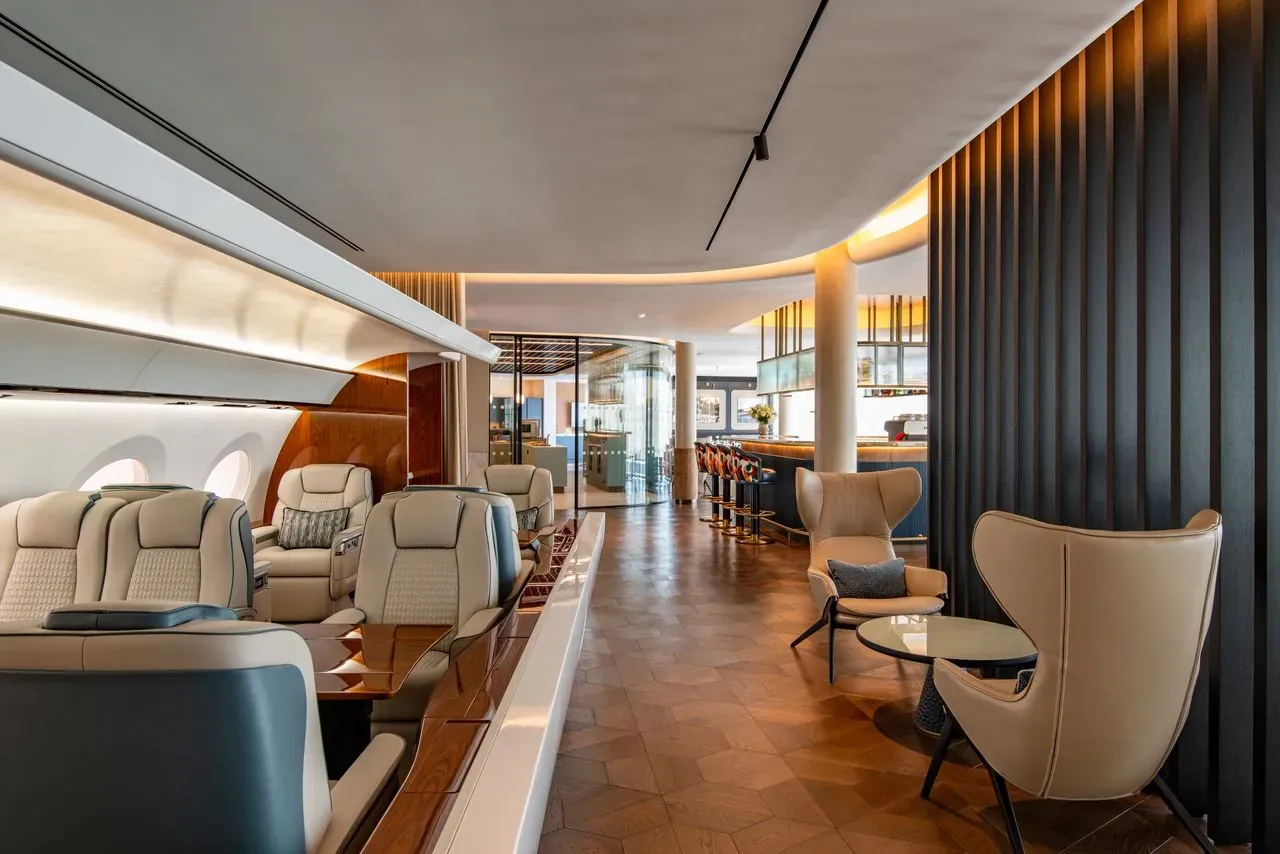
The private aviation terminal design at Farnborough integrates executive hospitality functionality with residential warmth through a dual-axis spatial flow. Architectural planning prioritizes privacy segregation and acoustic isolation. Natural illumination is maximized via high-transmittance curtain wall glazing, balanced by indoor architectural lighting operating on DALI 2.0 protocol. The lighting matrix transitions dynamically from 350 lux during operational daylight to 150 lux ambient illumination in evening hours, utilizing 2700K to 3000K warm color temperatures with Ultra-Low Glare (UGR < 19) optical lenses to optimize visual ergonomics for long-haul travelers. Interior branding departs from conventional industrial waiting lounges, adopting a sophisticated spatial narrative centered on residential comfort. Fixed joinery and loose FF&E assets serve as physical interfaces defining zone boundaries between open lounges, private conference suites, and dining areas. From an engineering standpoint, executing such high-occupancy executive spaces mandates strict structural integration where MEP conduits, concealed access panels, and acoustic insulation layers are seamlessly embedded into millwork framing, maintaining spatial clarity and long-term mechanical reliability under high-frequency operation.
Luxury FF&E Material Engineering & Joinery Breakdown
In high-traffic private aviation facilities like the Farnborough terminal, FF&E engineering demands strict material specifications and structural compliance to sustain continuous commercial use. Structural joinery and wall paneling utilize F1 grade low-formaldehyde moisture-resistant plywood (formaldehyde emission <= 0.3 mg/L). The core substrate comprises Eucalyptus multilayer plywood with a density exceeding 720 kg/m3 and a Modulus of Rupture (MOR) above 35 MPa, preventing long-term structural deflection under load. Surface finishes feature 0.6 mm natural smoked oak veneers treated with four polyurethane (PU) base sealers and a 2H hardness topcoat of anti-fingerprint matte waterborne polyurethane finish, ensuring elevated scratch resistance.
Hardware systems dictate component mechanical longevity. Cabinet doors are fitted with Blum Clip Top BLUMOTION 3D adjustable concealed hinges (110-degree opening), certified under EN 15570 Level 3 for over 200,000 operational cycles. Heavy-duty drawer mechanisms utilize King Slide or Grass Dynapro full-extension concealed undermount slides rated for a 50 kg dynamic load capacity with slider resistance kept below 15 N, maintaining smooth kinetic sliding under maximal cargo capacity.
Metal trimmings incorporate SUS304 stainless steel coated with PVD (Physical Vapor Deposition) titanium, achieving a film thickness of 0.3 to 0.5 microns and surface hardness exceeding HV 800. These components pass a 96-hour neutral salt spray test per ASTM B117. A 1.5 mm expansion joint filled with high-elasticity structural sealant is engineered between metal components and wooden panels, effectively absorbing differential thermal expansion stresses.
Natural stone countertops select 20 mm natural marble or granite reinforced on the underside with a 300 g/m2 high-tensile fiberglass mesh bonded via epoxy resin, maintaining a Modulus of Rupture above 12 MPa. Stone surfaces undergo double-coat fluorocarbon anti-staining treatments (water contact angle > 105 degrees) to prevent fluid absorption from acidic beverages.
Upholstery textiles engineered for public lounge seating must achieve over 40,000 cycles on the Martindale abrasion resistance test (ASTM D4966) with a pilling resistance rating of Grade 4. Fire retardancy strictly complies with BS 7176 Medium Hazard standards, passing the Crib 5 ignition source specification (peak heat release rate <= 5.2 kW) and BS 5852 Part 2. Interior foam cores utilize high-resilience flame-retardant polyurethane foam (density >= 45 kg/m3, 40% Compression Load Deflection at 3.8 kPa), limiting permanent compression set below 5% under continuous usage.
Hospitality Operations, Wear Analysis & TCO Model
From an asset management and airport operations perspective, FF&E assets in executive aviation terminals undergo rigorous physical wear over a 5 to 10-year operational lifecycle. Primary structural degradation points include sofa armrest wear, metallic coating abrasion from hand luggage, veneer impact damage along baseboards, and localized edge chipping on stone surfaces.
Deploying subpar material specifications leads to premature textile pilling, polyurethane delamination, and mechanical hardware failure by year two, incurring unscheduled CapEx remedies. Establishing an optimized Total Cost of Ownership (TCO) model is imperative. Increasing initial procurement CapEx by 15% to 20%—specifically investing in PVD titanium protective kickplates, Martindale 40,000+ abrasion fabrics, and deep fluorocarbon stone sealants—extends the major refurbishment interval from 3 years to 7+ years.
The TCO formula is expressed as: TCO = Initial Procurement & Installation (CapEx) + Preventative Maintenance (OpEx) + Downtime Revenue Losses (L) - Residual Asset Value (R). Lifecycle financial modeling confirms that high-specification FF&E engineering reduces cumulative 10-year maintenance and replacement expenditure by 42%. Furthermore, it eliminates operational disruption costs associated with closing executive lounges for emergency repairs. Semi-annual scheduled maintenance—focusing on sealant reapplication and hinge torque calibration—ensures peak asset performance.
Sunder Engineering Grounding & Subtropical Climate Defense
In subtropical island climates characterized by relative humidity levels of 75% to 85% and temperatures exceeding 32 degrees Celsius, wooden FF&E joinery is susceptible to moisture absorption, dimensional swelling, and lacquer delamination. Factory fabrication in such regions requires rigorous climate defense protocols.
All raw timber and plywood substrates undergo secondary kiln-drying and conditioning to lock equilibrium moisture content (EMC) strictly between 8% and 12% (compliant with GB/T 15104). During manufacturing, all unexposed backing panels, cut edges, and interior cavities receive a two-component epoxy vapor-barrier sealing coat, maintaining a Water Vapor Transmission Rate (WVTR) below 5 g/m2 per 24 hours to block ambient humidity ingress.
Structural joinery integrates traditional mortise-and-tenon joints engineered with CNC precision, maintaining a 0.8 mm micro-expansion tolerance sealed with DIN EN 204 D4-grade waterproof polyurethane adhesive. Production management utilizes off-site modular fabrication combined with on-site rapid assembly. Over 95% of cutting, veneering, sanding, and coating is completed in ISO 9001 factory environments. On-site work is restricted to mechanical cleat hanging and elastic silicone sealing, reducing site construction schedules by over 40% while preventing ambient moisture contamination of uncured finishes.
B2B Material & Inspection Specification Table
To enforce quality assurance across procurement and handover phases, engineering teams must execute inspection protocols compliant with the markdown table below:
| Component | Specification | Inspection Standard | Tolerance & Criteria |
|---|---|---|---|
| Joinery Substrate | F1 moisture-resistant plywood + 0.6mm oak veneer | GB/T 15104 / EN 312 | Moisture 8-12%, Formaldehyde ≤0.3mg/L |
| Hardware & Slides | Stainless steel soft-close hinge + undermount slide | EN 15570 Level 3 / ANSI BHMA | Fatigue ≥200,000 cycles, Dynamic load 50kg |
| PVD Metal Trim | SUS304 stainless steel with PVD titanium coating | ASTM B117 / ISO 4524 | Film thickness 0.3-0.5µm, Salt spray ≥96h |
| Stone Countertops | 20mm marble + 300g/m² fiberglass mesh backing | ASTM C99 / ASTM C170 | MOR ≥12MPa, Water contact angle >105° |
| Upholstery & Foam | Flame-retardant fabric + 45kg/m³ HR foam core | BS 7176 Medium / ASTM D4966 | Martindale ≥40,000 cycles, Crib 5 compliant |
Handover Directive: Quality auditing mandates digital calipers, moisture meters, and glossmeters. Panel joint tolerances must not exceed ±0.5 mm, with verticality and horizontality maintained within 1.0 mm/m.