Executive Summary
This white paper offers an in-depth analysis of the Jun Matcha Club project in Jakarta, dissecting its spatial aesthetics, premium FF&E craftsmanship, operational wear TCO model, and subtropical climate defense strategies. It comprehensively articulates material engineering and asset management principles for commercial furnishings in high-humidity environments. Focusing on F1 moisture-proof substrates, PVD titanium technology, Martindale-rated fabrics, and precise joinery, it aims to provide owners with long-term operational efficiency and environmental resilience.
Spatial Philosophy & Architectural Narrative
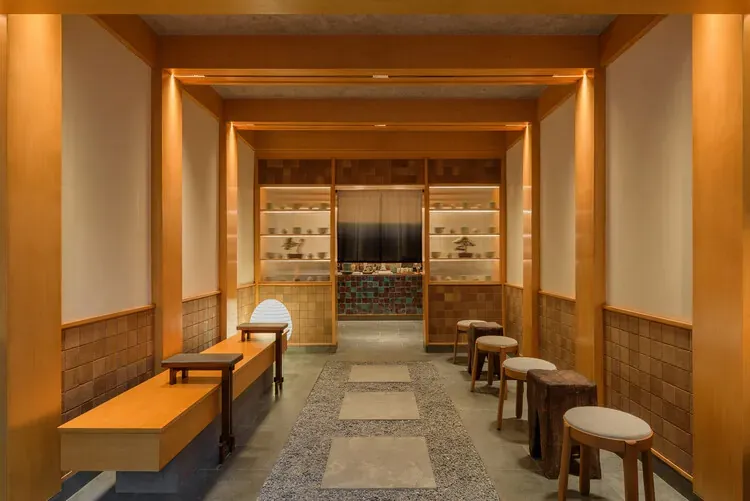
Located within South Jakarta’s bustling commercial hub, Jun Matcha Club’s design critically responds to the area’s burgeoning independent F&B scene by cultivating a contemplative space centered on the “matcha ritual.” The project’s spatial philosophy is deeply rooted in the values inherent in matcha culture—“attentiveness, restraint, and ritual”—and translates these through localized Indonesian craftsmanship and materials. Architecturally, the designers skillfully employ linear screens and minimalist geometric forms to construct layered spaces that feel both open and enclosed, guiding visitors from the bustling street into a state of calm. Natural lighting is a pivotal element; expansive windows and skylights introduce soft daylight, complementing the warm timber and stone interiors, fostering a serene yet sophisticated atmosphere while mitigating direct glare that could disrupt the sensory experience. In terms of circulation, the journey from the transitional entrance through a subdued corridor, culminating in the core matcha preparation and tasting areas, is meticulously planned, enhancing the progressive sense of “ritual.” Fixed FF&E plays a crucial role in this narrative; its low-profile volumes and horizontal lines not only define distinct functional zones but also, with their understated presence, guide the gaze, encouraging visitors to slow down and engage with the present moment. Table and seating configurations are ergonomically considered for privacy, with appropriate spacing to ensure guests maintain personal space while enjoying their matcha, aligning with the brand’s “restraint” ethos. This profound understanding of spatial philosophy ensures that FF&E transcends mere functionality, becoming an integral part of the architectural narrative, collectively shaping Jun Matcha Club’s unique brand experience and underscoring its commitment to detail and quality.
Luxury FF&E Material Engineering & Joinery Breakdown
The superior quality of fixed FF&E is not merely reflected in aesthetic design but deeply rooted in its core material engineering and exquisite craftsmanship. For the Jun Matcha Club project, considering its function as a high-frequency commercial space, Sunder Engineering recommends a series of FF&E materials and structural applications compliant with international hospitality standards to ensure long-term performance and visual integrity. Regarding wood substrates, we specify F1 grade moisture-proof, low-formaldehyde plywood. Its formaldehyde emission levels are significantly below national standards, ensuring indoor air quality meets health regulations. Moisture resistance is paramount in Jakarta’s high-humidity environment; achieved through multi-layered, vertically cross-grained veneer pressing, this material not only provides excellent structural stability, effectively resisting deformation, cracking, and warping caused by humidity, but also boasts superior nail and screw retention, making it an ideal substrate for cabinet bodies, wall panels, and tabletops. For real wood veneer applications, we utilize AA-grade natural wood veneers with a thickness of 0.6mm or more, meticulously cut and grain-matched to ensure visual continuity and a luxurious finish. Edge banding employs high-polymer edge banding technology, using hot-melt adhesive and automated machinery to create a tight bond between the edge band and the board, effectively preventing moisture penetration while enhancing impact resistance. Hardware load-bearing and hinge fatigue life are critical determinants of furniture durability. For drawer slides, we recommend heavy-duty ball-bearing slides certified by German LGA for quality, with a lifespan exceeding 100,000 cycles and a rated load capacity of 45 kg, ensuring smooth operation even with frequent use. Cabinet door hinges should be soft-close stainless steel hinges, tested for 200,000 cycles, meeting the high standards for anti-corrosion performance and fatigue life required in commercial spaces. Metal trimming utilizes PVD (Physical Vapor Deposition) titanium stainless steel. Compared to traditional electroplating, PVD coatings offer superior hardness (Mohs hardness 8), abrasion resistance, and excellent corrosion resistance, effectively resisting coffee stains, cleaning agent corrosion, and daily scratches, ensuring metal trims maintain their original luster and color stability over long-term use. The connection between metal trims and woodwork involves precision grooving and specialized adhesives for seamless integration and structural stability. For natural stone applications on bar counters and tabletops, the reverse side must be reinforced with fiberglass anti-crack mesh, bonded with epoxy resin. This significantly enhances the stone’s flexural strength and shock resistance, effectively preventing fractures due to stress concentration or impact. The stone surface is treated with a penetrating impregnating sealant to provide excellent stain, water, and oil repellency, facilitating daily cleaning and maintenance. Fabric selection is crucial for public areas and high-contact surfaces. All sofa and upholstered fixed FF&E must feature fabrics with a Martindale abrasion resistance rating of 40,000 rubs or more, ensuring their aesthetic and structural integrity under high-frequency friction. Concurrently, to comply with public safety regulations, fabrics must meet the British Standard BS 7176 Medium Hazard fire retardancy standard, requiring resistance to both cigarette and match flames, thereby minimizing fire risk and safeguarding patrons and assets. For surface coatings, environmentally friendly PU finishes complying with Japanese F☆☆☆☆ standards are applied, ensuring coating hardness (H-2H), scratch resistance, and human safety.
Hospitality Operations, Wear Analysis & TCO Model
For owners of hotels or high-end commercial spaces, FF&E procurement decisions extend beyond initial Capital Expenditure (CapEx) to encompass long-term operational costs and maintenance efficiency. This is the essence of the Total Cost of Ownership (TCO) model. Over a 5 to 10-year operational cycle, FF&E in guest rooms and public areas will encounter high-frequency usage and potential wear points. High-Frequency Wear Point Analysis: 1. Guest Rooms: Headboard edges frequently suffer damage from luggage or cleaning trolleys. Desk and mini-bar edges and surfaces are prone to scratches or stains from liquid spills, cups, and dishes. Wardrobe doors and drawer fronts, due to frequent opening and closing, challenge the fatigue life of hinges and slides, as well as the abrasion resistance and moisture-proof qualities of the panels. Bathroom door frames and mirror cabinet edges are also high-risk areas for moisture penetration and impact. 2. Public Areas: Lobby reception counter surfaces and kick plates are highly susceptible to scratches and dents from luggage or foot traffic. Restaurant and cafe tables, chair legs, and bar counter surfaces endure frequent cleaning and impacts. Corridor wall panels and elevator lobby furniture face collisions from trolleys, cleaning equipment, and heavy human traffic. TCO Defense Model Construction: Sunder Engineering advises owners to select materials and construction methods capable of resisting these high-frequency wear points from the outset of procurement to achieve optimal TCO. For instance, using high-hardness, scratch-resistant PVD titanium stainless steel trim or High-Pressure Laminate (HPL) for countertops and edges, rather than merely solid wood or painted surfaces. Utilizing F1 grade moisture-proof plywood for wood substrates, treated with double-sided sealing, can significantly extend furniture lifespan in humid environments, reducing the risk of premature replacement due to panel expansion or deformation. Hardware should be sourced from brands subjected to rigorous fatigue testing, ensuring functionality remains intact after hundreds of thousands of cycles. Maintenance Budget and Replacement Cycle: By selecting durable materials, routine cleaning and minor repairs (e.g., touch-up paint, localized sanding) can keep the annual maintenance budget below 0.5% of the total asset value. For critical components like high-abrasion fabrics, even with daily high-frequency use, their replacement cycle can be extended from the traditional 3-5 years to 7-10 years, drastically reducing future CapEx for replacements and minimizing operational downtime. Investment Return Evaluation: While the initial investment in high-quality FF&E may be slightly higher than the market average, in the long run, it effectively reduces the frequency of damage-related repairs or premature replacements, lowers labor and material replacement costs, and prevents compromised brand image due to damaged furniture. This strategy not only safeguards the visual integrity and functionality of assets but also, through precise TCO budget management, creates more resilient and sustainable commercial value for owners.
Sunder Engineering Grounding & Subtropical Climate Defense
As a typical island subtropical climate, Jakarta experiences year-round high temperatures and humidity (relative humidity commonly between 75-85%), posing severe challenges to the durability of fixed FF&E. Leveraging decades of manufacturing and engineering experience in the Asia-Pacific region, Sunder Engineering proposes a series of manufacturing grounding and climate defense guidelines specifically tailored for such environments, ensuring the long-term stability and performance of FF&E products. Moisture Content Control: The core issue for wooden materials in subtropical climates is their sensitivity to humidity. Sunder recommends that all solid wood and wood-based substrates undergo precise moisture content control before processing, with the target range accurately set between 8-12%. This value has been long-validated to effectively balance the expansion and contraction stresses of materials in the local environment, preventing wood cracking or deformation due to abrupt humidity changes. Double-sided Moisture-proof Sealing: All wooden panels, including non-visible surfaces such as cabinet interiors, backs, or bottoms, must be treated with at least two coats of high-polymer environmental moisture-proof finish. This double-sided sealing strategy creates a comprehensive moisture barrier, effectively preventing environmental humidity from penetrating the wood from any direction, achieving internal and external moisture balance, and maximizing its moisture resistance. Compared to single-sided or incomplete sealing, this significantly extends furniture lifespan. Joinery Stress Allowance & Structural Reinforcement: In traditional woodworking joinery, without proper stress allowance, high-humidity environments can lead to stress concentration due to minor expansion or contraction of the wood, eventually causing loosening or cracking. In Sunder’s precise joinery designs, microscopic expansion gaps are pre-engineered, combined with professional woodworking adhesives and mechanical fasteners (e.g., dovetail or wedged tenon joints with screws), to ensure structural integrity despite minor deformation. For large panels, aluminum or steel structural reinforcements are incorporated to counteract the unique “breathing” effect of wood in island climates. Modular Prefabrication for Timeline Control: To optimize production efficiency and reduce on-site construction uncertainties, Sunder advocates for modular FF&E prefabrication strategies. Most furniture components undergo precision machining, finishing, and preliminary assembly in a controlled factory environment, ensuring consistent quality and accuracy. Upon arrival at the site, only rapid final assembly and installation are required. This strategy not only significantly shortens on-site construction time, reducing operational impact, but also allows for more effective control over wood moisture content and finishing quality in a factory setting, especially in high-humidity environments, minimizing potential damage to semi-finished products from on-site humidity, thereby ensuring both project progress and quality targets are met. Island Climate Expansion Control & Moisture Isolation: For junctions between wood and dissimilar materials (e.g., metal), elastic sealants and structural cushioning pads are used to accommodate differential expansion coefficients under thermal and hygroscopic changes. At the base of furniture and points of contact with walls, moisture-proof skirting or elevated leg designs are incorporated to create a physical moisture isolation zone, preventing ground moisture from directly transferring to the main furniture body, further enhancing moisture resistance. These comprehensive engineering strategies collectively form the cornerstone of Sunder’s commitment to providing high-performance, long-lasting FF&E solutions for clients in subtropical island environments.
B2B Material & Inspection Specification Table
To ensure FF&E fixed furniture meets design and engineering standards and aligns with long-term operational requirements, Sunder Engineering recommends adopting the following B2B material and inspection specifications. This standardized process aims to provide owners with clear acceptance criteria, ensuring quality control and data transparency at every stage.
| Component | Material & Craftsmanship Specification | International Inspection Standard | Acceptance Tolerance/Indicator |
|---|---|---|---|
| Wood Substrate | F1 Moisture-proof, Low-formaldehyde Plywood, Double-sided Sealed | CNS 2215 (F1), CNS 8058, ASTM D4442 | Formaldehyde <0.3mg/L, Moisture Content 8-12%, Warpage <0.2mm/m |
| Wood Veneer | AA-grade 0.6mm+ Natural Wood Veneer, Precision Grain Match, Polymer Edge Banding | ISO 17228, EN 438 | Surface Flatness <0.1mm, Color Difference <Delta E 3, Edge Banding Adhesion >95% |
| Metal Trim | PVD Titanium Stainless Steel (SUS 304), 1.2mm Thickness | ASTM B733, ISO 2409 | Film Thickness >0.8μm, Adhesion 0, Salt Spray >500hr, Color Consistency |
| Stone Countertop | Natural Granite/Marble, Fiberglass Anti-crack Mesh Backing, Penetrating Sealer | ASTM C97, ASTM C1352 | Flatness <0.5mm/m, Flexural Strength >15 MPa, Water Absorption <0.5% |
| Upholstery Fabric | Martindale 40,000+ Rubs, BS 7176 Medium Hazard Fire Retardant | BS EN ISO 12947-2, BS 7176 | No significant wear, Fire Retardancy compliant, Color Fastness >4 |
| Hardware Hinge | Stainless Steel Soft-close Hinge, 200,000 Cycle Test | ANSI/BHMA A156.9, EN 1935 | Smooth operation, No abnormal noise, Fatigue Life >200k cycles, No sag under load |
| Drawer Slide | Heavy-duty Ball Bearing Slide, 100,000 Cycle Test, 45kg Load Capacity | ANSI/BHMA A156.9, EN 15338 | Sliding Resistance <15N, Fatigue Life >100k cycles, No sticking under load |
| Surface Finish | Eco-friendly PU Finish, Japan F☆☆☆☆ Compliant, H-2H Hardness | JIS A 5908, ASTM D3359 | Film Thickness >50μm, Adhesion 0, Scratch Resistance H-2H, Gloss Difference <5% |
Acceptance Guidelines:
- Visual Inspection: Furniture exterior should be free from scratches, dents, color variations, or stains. Wood veneer grain matching should be continuous and natural, and edge banding lines straight and tightly sealed.
- Functional Testing: All movable components (drawers, doors) should open and close smoothly without sticking or abnormal noise; hardware should be secure and without looseness.
- Dimensions and Tolerances: Use a laser distance meter or tape measure to verify that overall furniture dimensions and structural tolerances are within specified ranges.
- Document Verification: On-site acceptance requires verification of material certificates, test reports, and original factory warranties.
- Environmental Adaptability: Check for panel flatness and absence of significant expansion or contraction, especially crucial in subtropical high-humidity environments.
These detailed specifications and acceptance standards serve not only as a guarantee of quality but also as a long-term commitment to asset value, assisting owners in efficient supplier management and risk control.