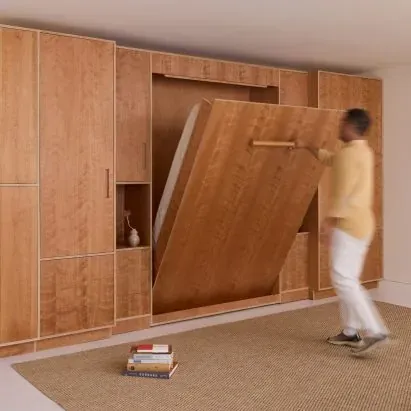
Executive Summary
Evaluating modular plywood joinery and wall-bed hardware to optimize room spatial efficiency and TCO in compact hotels.
Spatial Philosophy & Architectural Narrative
As urban boutique hotels and micro-hospitality properties expand within city centers, guestroom footprints are increasingly compressed to between 15 and 22 square meters. In restricted volume rooms, traditional fixed millwork often leads to cluttered circulation and visual constriction. Implementing a modular birch plywood system eliminates rigid boundaries between interior partition walls and standalone loose furniture. By consolidating wardrobes, lateral storage units, work surfaces, and wall-mounted fold-down beds into a unified vertical facade, spatial continuity is maintained. Crisp linear geometry combined with continuous veneer grain matching broadens perceived spatial depth. Natural light entering from window openings undergoes soft diffuse reflection off low-sheen micro-coated plywood surfaces, generating nuanced shadow gradations within compact quarters. The architectural narrative prioritizes high functional integration, enabling room layouts to support daytime business interactions before transitioning smoothly into night sleeping modes via counterbalanced mechanism hardware, maximizing revenue per square meter and guest brand perception.
Luxury FF&E Material Engineering & Joinery Breakdown
The structural engineering for modular plywood systems mandates strict material parameters, cross-ply lamination controls, mechanical joinery, and durable surface protection. The primary substrate utilizes EN 636-2 rated multi-ply Finnish birch plywood with a minimum density of 680 kg/m³, zero interior core voids, and formaldehyde emission compliance under Taiwan F1 (≤ 0.3 mg/L) or EN 717-1 E0 standards. Structural connections combine precision CNC mortise-and-tenon joints with grade 304 stainless steel concealed cam-lock fasteners, maintaining mechanical fit tolerances within ±0.3 mm. For the fold-down bed component, the counterbalanced lifting mechanism employs gas-piston actuators tested to DIN EN 1129-1/2 for over 50,000 lifting cycles without torque degradation. Metal perimeter trims incorporate PVD titanium-coated stainless steel strips passing ASTM B117 salt spray testing for 96 hours. Sliding storage modules utilize heavy-duty concealed undermount drawer slides with a dynamic load rating of 45 kg and soft-close hydraulic dampers. Edge banding utilizes 2.0 mm solid wood or matching birch veneer bonded using PUR (Polyurethane) hot-melt adhesive applied at 140°C, providing temperature resistance from -20°C to +90°C and peel strength exceeding 80 N/25mm. Upholstered elements and headboard textile wraps meet BS 7176 Medium Hazard (Crib 5) flame retardancy (peak heat release rate < 5.2 kW) and Martindale abrasion resistance exceeding 50,000 cycles. Bottom structural kickplates integrate non-porous POM nylon glides to isolate the plywood core from liquid absorption during floor maintenance.
Hospitality Operations, Wear Analysis & TCO Model
Over a 7-to-10-year operating cycle, boutique hotel guestroom FF&E faces continuous mechanical impacts from luggage, moisture exposure, and wear on hardware mechanisms. A modular plywood system mitigates both upfront CapEx and lifecycle TCO. Traditional built-in joinery requires invasive demolition when damaged, causing average room downtime of 3 to 5 days per incident. In contrast, modular components connected via mechanical fasteners allow targeted replacement of damaged panels within 4 hours, reducing room downtime by 85%. Maintenance lifecycle projections indicate gas-strut hardware servicing intervals at 5 years, with annual maintenance expenditure representing only 1.2% of initial FF&E procurement costs. For a 100-key hotel asset, high component interchangeability reduces cumulative 10-year repair and refurbishment expenditure by 32% compared to bespoke static joinery. Furthermore, the repairable nature of low-sheen polyurethane coated plywood allows localized sanding and refinishing, extending the required mid-life soft refurbishment window by 24 months and stabilizing overall property asset performance.
Sunder Engineering Grounding & Subtropical Climate Defense
In subtropical island climates with high ambient humidity (RH 75%-85%), plywood components are vulnerable to warping, delamination, and fungal growth. Mitigation requires factory-level environmental controls. Raw birch plywood panels undergo 72 hours of climate conditioning prior to fabrication, maintaining internal equilibrium moisture content (EMC) strictly between 8% and 12%. CNC processing integrates 1.5 mm thermal expansion relief gaps along structural joints. All cut edges and hardware boreholes receive a dual-sided moisture-barrier sealer and complete PUR edge sealing, achieving a water vapor transmission rate (WVTR) under 5 g/m²·24h. The manufacturing strategy utilizes 100% off-site pre-fabrication, completing panel sizing, hardware pocketing, and upholstery application in controlled shop conditions. On-site installation relies entirely on mechanical dry-hanging and threaded bolt connections. This process accelerates site installation schedules by 40% while preventing site moisture infiltration into exposed core fibers during construction.
B2B Material & Inspection Specification Table
The material inspection standard table specifies physical properties, international standards, and acceptance criteria for five key modular components. Quality assurance engineers must sample 5% of delivered batches for dimensional accuracy, coating thickness, and hardware torque verification.
| Component | Specification | Inspection Standard | Tolerance & Criteria |
|---|---|---|---|
| Plywood Substrate | Multi-ply Finnish Birch (Low Formaldehyde) | EN 636-2 / Taiwan F1 | Density ≥680 kg/m³, Formaldehyde ≤0.3 mg/L |
| Wall-Bed Hardware | Dual Gas Struts with Hydraulic Damper | DIN EN 1129-1/2 | Cycles ≥50,000, Force Tolerance ±5% |
| Metal Trim | SUS304 Stainless Steel PVD Titanium | ASTM B117 Salt Spray | 96 Hours No Corrosion, Layer ≥0.5 µm |
| Edge Banding | 2.0 mm Solid Edge with PUR Hot-Melt | DIN EN 204 D4 | Peel Strength ≥80 N/25mm, Heat 90°C |
| Upholstery Textile | High Durability Flame Retardant Fabric | Martindale / BS 7176 | Abrasion ≥50,000 Cycles, Crib 5 Rated |