Executive Summary
Addressing FF&E durability and high-traffic wear in hotel conversions through precise joinery standards and TCO modeling.
Spatial Philosophy & Architectural Narrative
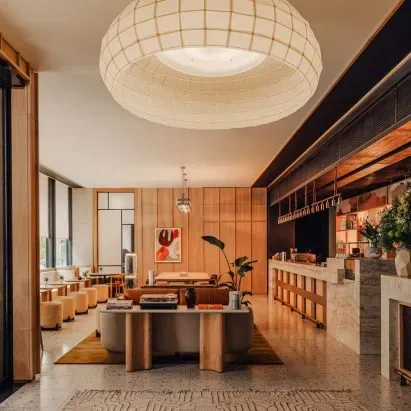
The Aethos Shoreditch project in London, housed within the architectural envelope designed by Ron Arad Associates, represents an architectural refit of an existing hospitality structure. Astet Studio engineered the interior transformation by layering Japanese material aesthetics onto the exposed raw concrete and structural steel framework. The spatial hierarchy utilizes low-saturation natural timber veneers, timber slatted screens, and concealed indirect LED lighting to guide guest movement seamlessly from public lounges to guestrooms. Natural daylight penetrates through the expansive curtain wall, softened by micro-cement flooring and matte-finished cabinetry surfaces to eliminate glare. From a hotel asset management standpoint, the primary technical challenge lies in anchoring bespoke fixed joinery onto uneven existing concrete substrates while maintaining precise visual alignment and meeting brand standards for high-occupancy boutique operations.
Luxury FF&E Material Engineering & Joinery Breakdown
To withstand high-frequency commercial use, fixed joinery and loose FF&E must comply with rigorous material and structural specifications. Wood substrates are specified with F1/E0 grade low-formaldehyde moisture-resistant multi-layer plywood with a minimum thickness of 18 mm. All cutouts and joints must be sealed with polyurethane edge-banding adhesives to mitigate moisture ingress. Natural timber veneers are applied at a minimum thickness of 0.6 mm, finished with a two-component polyurethane matte sealer and topcoat yielding a surface hardness of 2H. Hardware specifications require heavy-duty three-way adjustable concealed hinges and full-extension undermount drawer slides compliant with EN 15570 Level 3 standards, rated for 100,000 operational cycles under a dynamic load capacity of 40 kg per pair, fully integrated with soft-closing dampers. Metal trims utilize AISI 304 stainless steel with Physical Vapor Deposition (PVD) titanium coating (film thickness 0.3-0.5 μm), demonstrating zero corrosion after 248 hours of ASTM B117 salt spray testing. Metal profiles are secured using concealed mechanical fasteners or structural adhesives. Natural stone vanity tops and tabletops are reinforced on the underside with a carbon-fiber mesh and 8 mm plywood backing to absorb mechanical stress, treated with fluorochemical penetrating sealers to reduce water absorption below 0.1%. Upholstery fabrics must sustain 40,000 Martindale abrasion cycles, while natural leather must possess a tensile strength exceeding 15 N/mm². Fire retardancy strictly adheres to BS 7176 Medium Hazard specifications (passing both Crib 5 ignition source 5 and BS 5852 smoldering tests). High-resilience polyurethane foam cores require a density of 45-50 kg/m³ with an Impression Load Deflection rating of 30-35 lbs, maintaining dimensional stability over prolonged service.
Hospitality Operations, Wear Analysis & TCO Model
In hospitality asset management, initial FF&E procurement accounts for only 40-45% of Total Cost of Ownership (TCO), with the remaining 55-60% spent on ongoing maintenance, localized repairs, and room downtime losses. High-impact areas such as luggage benches, credenza edges, and headboard corners often experience veneer chipping within 18 to 24 months if standard low-density MDF and thin veneers are deployed. This results in Out-of-Order room status and daily revenue loss. To optimize the CapEx financial model, joinery designs must integrate protective engineering solutions: applying 1.5 mm PVD stainless steel protective profiles or solid hardwood edge bands (≥8 mm) at high-impact zones, alongside modular mounting systems. This modularity allows engineering staff to replace damaged panels or drawer fronts within 30 minutes using pre-manufactured attic stock without disrupting room sales. Preventative maintenance schedules dictate hardware re-tightening and lubrication every 12 months, with timber touch-up refinishing and stone re-sealing every 24 months. Financial modeling shows that while specifying F1 plywood, PVD metallic accents, and Crib 5 flame-retardant upholstery increases initial FF&E CapEx by 12-15%, it extends the major refurbishment lifecycle from 5 years to 8-10 years, reducing cumulative maintenance TCO by 28% and shortening CapEx payback to 3.2 years.
Sunder Engineering Grounding & Subtropical Climate Defense
In Asian-Pacific subtropical island environments, ambient relative humidity stays between 75-85%, posing severe risks of timber swelling, warping, and fungal growth. Factory fabrication protocol mandates strict control of wood moisture content between 8-12%. Prior to secondary machining, raw panels must undergo a 72-hour conditioning period in climate-controlled workshops to relieve internal stresses. All concealed wood faces, including back panels and undersides, must receive a double-sided sealing application consisting of two coats of moisture-barrier primer to prevent asymmetrical moisture absorption. Solid wood joints and slatted acoustic features must incorporate 1.5-2.0 mm expansion gaps filled with high-elasticity silicone sealant to accommodate hygrothermal movement. Implementing off-site modular fabrication—where 90% of joinery assembly and spray finishing are completed in factory conditions—reduces site installation timelines by 35% while eliminating on-site VOC emissions and finish inconsistency.
B2B Material & Inspection Specification Table
To guarantee quality consistency and auditability across hospitality FF&E procurement, project management teams must enforce standardized material and acceptance criteria. The matrix below outlines specifications, testing protocols, and tolerances:
| Component | Specification | Inspection Standard | Tolerance & Criteria |
|---|---|---|---|
| Millwork Substrate | F1 low-formaldehyde moisture-resistant plywood, ≥18mm | CNS 1349 / GB/T 9846 | Formaldehyde ≤0.3 mg/L, Thickness tol. ±0.3 mm |
| PVD Metal Trim | AISI 304 stainless steel with PVD titanium coat (0.3-0.5μm) | ASTM B117 Salt Spray | Zero rust after 248 hrs, Color difference ΔE ≤0.5 |
| Concealed Hinges | Heavy-duty steel hinges with integrated soft-close | EN 15570 Level 3 | 100,000 cycles, Dynamic load rating ≥40 kg |
| Stone Countertops | Natural marble with carbon mesh & 8mm plywood backing | ASTM C97 / ASTM C170 | Water absorption <0.1%, Flatness tol. ±0.5 mm/m |
| Upholstery & Foam | High-resilience foam (45 kg/m³) with commercial fabric | BS 7176 / ISO 12947-2 | Martindale ≥40,000 cycles, Crib 5 compliant |
Acceptance Protocol: Post-installation inspection requires laser leveling checks for alignment. Adjacent cabinet door gaps must measure 2.0 mm ±0.3 mm, with slide operating force kept below 15 N.