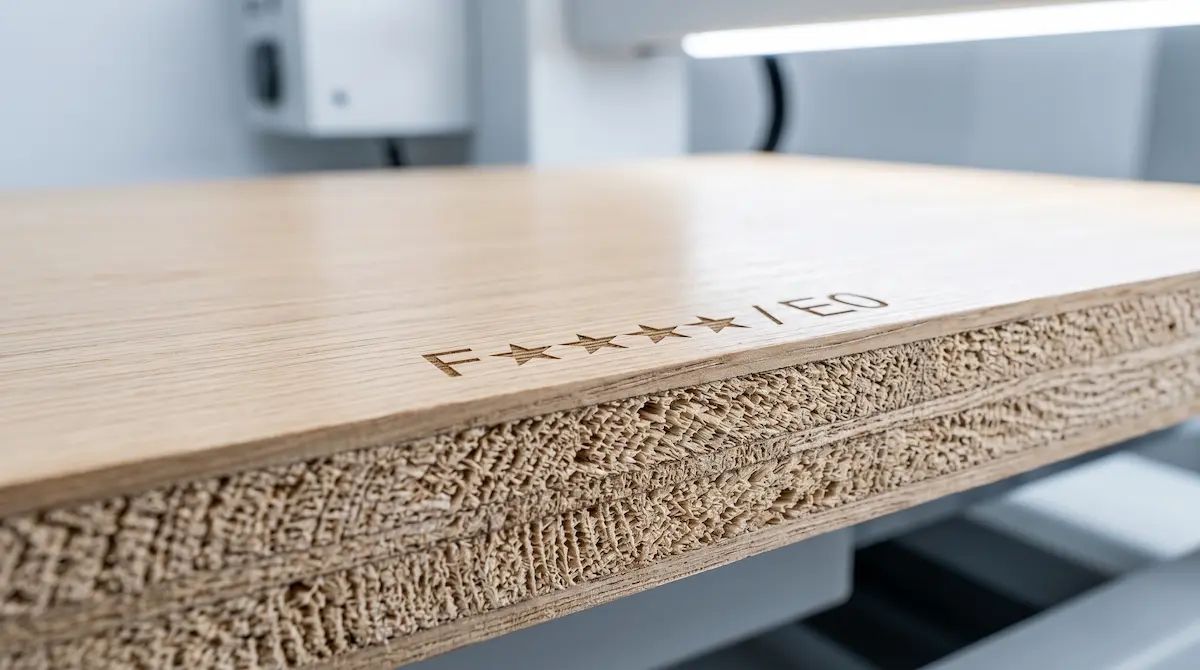
JIS A 1460 works like this: test pieces cut from the panel hang above 300 mL of distilled water inside a sealed desiccator for 24 hours, and the formaldehyde that migrates into that water is reported in mg/L. The figure describes the panel. After it leaves the desiccator the panel is still edged, coated, assembled and carried into a room, and urea-formaldehyde edge glue and a solvent-borne topcoat each add emission of their own; what a guest breathes is a concentration in air, which only the chamber methods (ASTM E1333, EN 717-1, ISO 16000) report. Most tenders ask for the desiccator report alone, which is how a batch of JIS F☆☆☆☆ panels becomes casework that leaves a guestroom reading high on TVOC. The question of how many days until the room can be sold is answered by chamber data and an on-site reading.
During traditional B2B procurement strategies and low-bid tendering, procurement teams frequently evaluate only veneer samples under showroom lighting, overlooking the hazardous Free Formaldehyde and Total Volatile Organic Compounds (TVOC) latent within core boards and adhesives. If specifications permit low-cost Urea-Formaldehyde (UF) resins, closed HVAC cycles and humid environments trigger continuous chemical hydrolysis, releasing free formaldehyde over a 3- to 15-year period. This causes acute respiratory discomfort, guest OTA negative reviews, and forces properties into a 3- to 4-week “post-handover ventilation delay”, resulting in substantial lost room revenue.
Sunder integrates B2B Value Engineering (VE) and molecular-level environmental chemical engineering, specifying JIS F☆☆☆☆ (F4-Star) substrates, MDI formaldehyde-free binders and low-VOC UV-cured finishes, with the aim of removing the post-handover ventilation period and producing documents the LEED v4.1 and WELL v2 low-emitting credits can accept.
1. Formaldehyde Off-Gassing Kinetics: UF Hydrolysis vs. MDI Covalent Polyurethane Bonds
Pungent post-renovation odors originate from the reversible hydrolysis of Urea-Formaldehyde (UF) resins:
+-------------------------------------------------------------------------+
|        Adhesive Molecular Stability & Formaldehyde Off-Gassing Physics  |
+-------------------------------------------------------------------------+
|  【Conventional Urea-Formaldehyde Resin (UF Glue - Weak Physical Bond)】|
|   Heat (T > 28°C) + Humidity (RH > 75%) ──► Moisture hydrolyzes bonds   |
|                                         ──► Free HCHO off-gassing 3-15y |
|                                                                         |
|  【Sunder MDI Polyurethane Ecological Binder (Methylene Diphenyl)】     |
|   MDI Isocyanate Group (-NCO) + Wood Hydroxyl (-OH) ──► Polyurethane    |
|                                                       covalent bond     |
|                                                     ──► Zero hydrolysis |
|                                                     ──► HCHO near zero  |
+-------------------------------------------------------------------------+
+-------------------------------------------------------------------------+
| Room Formaldehyde Concentration over Time: Low-Bid vs. Sunder F4★ |
+-------------------------------------------------------------------------+
| Indoor HCHO Concentration (mg/m³) |
| ▲ |
| 0.20│ [Low-Spec E1/E2 FF&E: Toxic Peak] ──► Requires 21-30 Days Venting |
| │ \ ➔ Severe Revenue Loss |
| 0.08│ ────────\──────────────────────── (WHO / WELL Safety Limit: 0.08) |
| │ \ |
| 0.02│ \ [Sunder JIS F☆☆☆☆ + MDI: Zero Off-Gassing Day 1] |
| │ \═════════════════════════════════════════════════════ |
| 0 └───────────────────────────────────────────────────────► Time (Day)|
| Day 1 (Installation) Day 7 Day 21 |
+-------------------------------------------------------------------------+2. International Formaldehyde & VOC Emission Tier Benchmark
International Formaldehyde Emission & IAQ Standard Matrix
| Standard Framework | Emission Limit | Testing Method & Scope |
|---|---|---|
| Japan JIS F☆☆☆☆ | ≤ 0.3 mg/L (Average) | JIS A 1460 Desiccator |
| USA CARB P2 / TSCA | ≤ 0.05 ppm (~0.06 mg/m³) | ASTM E1333 Large Chamber |
| EU EN 717-1 E0 | ≤ 0.05 ppm (≤ 0.062 mg/m³) | 1m³ Environmental Chamb. |
| Taiwan CNS 2215 F1 | ≤ 0.3 mg/L | CNS Desiccator Method |
| Standard E1 (Floor) | ≤ 1.5 mg/L (~0.124 mg/m³) | Requires 21-Day Venting |
3. Sunder 4-Tier Low-Emission Green Material & Chemical Hierarchy
+-------------------------------------------------------------------------+
|         Sunder Non-Toxic Casework 4-Tier Material Architecture          |
+-------------------------------------------------------------------------+
|  [Layer 1: Coating System]   100% Solids UV-Cured / Waterborne PU Lacquer|
|                              (TVOC Emission Rate < 0.2 mg/m³, Zero Benzene)|
|                                │                                        |
|  [Layer 2: Edge Fusion]      German Reactive PUR Hot-Melt (Zero VOC)    |
|                                │                                        |
|  [Layer 3: Core Substrate]   JIS F☆☆☆☆ / Medical MDI Birch Core Multi-Ply|
|                              (Formaldehyde Emission <= 0.2 mg/L)        |
|                                │                                        |
|  [Layer 4: Sealed Backing]   Vacuum-Sprayed Moisture & Gas Barrier Coat |
+-------------------------------------------------------------------------+
4. Actuarial Quantification: Eliminating Ventilation Delays Across 300 Keys
Actuarial revenue modeling for a 300-key new-build five-star luxury property with NTD 6,000 ADR and 75% forecasted occupancy:
300-Key Hotel Post-Handover Ventilation Revenue Model
| Actuarial Parameter | Conventional E1 Spec | Sunder JIS F☆☆☆☆ |
|---|---|---|
| Required Airing Out Period | 21 Days (Open windows) | 0 Days (Day 1 Go) |
| Daily Revenue / Room (ADR x 75%) | NT$ 4,500 / Room / Day | NT$ 4,500 / Room / Day |
| Daily Property Revenue (300 rms) | NT$ 1,350,000 / Day | NT$ 1,350,000 |
| Direct 21-Day Revenue Lost | NT$ 28,350,000 (Lost) | NT$ 0 (Captured) |
| Chemical Remediation Expense | NT$ 600k ~ 900k | NT$ 0 |
| Odor-Related Guest Refunds | NT$ 300,000+ / Year | 0 Odor Claims |
| LEED v4.1 / WELL Credits Earned | 0 Points | Full IAQ Credits |
The table models 300 keys at NTD 6,000 ADR, 75% occupancy and a 21-day ventilation period, which values those 21 days at roughly NTD 28,350,000. It is a model, not a measurement: where the programme already carries 21 days of float, or the property hands over floor by floor, most of that amount never reaches the P&L.
5. Total Cost of Ownership (TCO): Low-Grade Panels vs. Sunder Non-Toxic Engineering
10-Year TCO Evaluation: Low-Spec UF Boards vs. Sunder F☆☆☆☆ Ecology
| Evaluation Vector | Low-Spec UF Particleboard | Sunder JIS F☆☆☆☆ |
|---|---|---|
| Off-Gassing Lifecycle | 3 to 15 Years Continuous | Permanent Zero Odor |
| Initial Room Odor | Pungent, Eye-Irritating | Pure Natural Scent |
| Opening Downtime | 3 to 4 Weeks Closed Venting | Zero Days (Day 1 Go) |
| OTA Odor Negative Rev. | 5% ~ 8% Bad Reviews | 0 Odor Complaints |
| Green Building Support | Fails LEED / WELL Criteria | Full Credits Earned |
| 10-Year Cumulative TCO | Baseline (100% + Idle Loss) | Reduced to 30% |
6. Conclusion: Engineering Wellness into Commercial Asset Velocity
In modern luxury hospitality where ESG stewardship and guest wellness dictate market dominance, non-toxic indoor air quality is not an abstract slogan; it is active production capital that governs room turnover speed, immediate cash flow generation, and multinational corporate procurement alignment.
Sunder enforces Japan JIS F☆☆☆☆ standards, MDI eco-adhesives, and ISO 16000 environmental chamber verification across all manufacturing lines. Two documents are worth asking for at acceptance: the JIS A 1460 desiccator report for the substrate, and ISO 16000 chamber data on the finished item or a same-batch sample. The first grades the panel; only the second corresponds to the air a guest breathes.