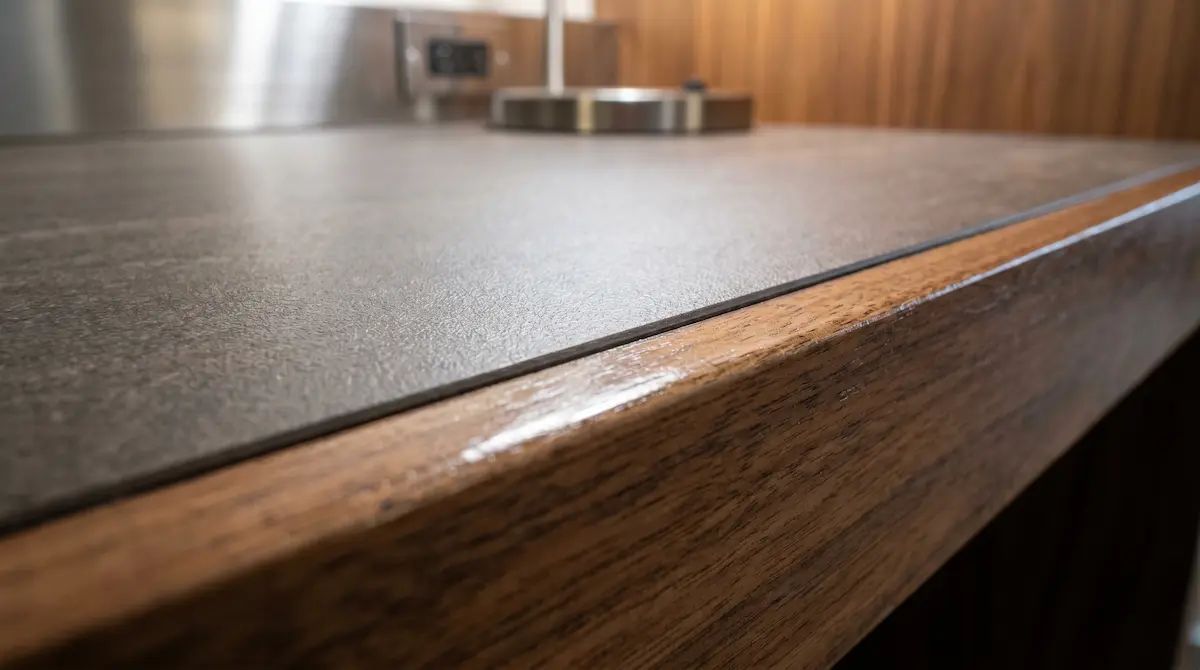
The room attendant’s cart comes in and the first job is a 75% alcohol wipe across the desktop, the armrests and the headboard. Three passes a day per room is more than a thousand chemical contacts a year, on top of the mechanical work done by luggage wheels, keys and pen caps. The two wear paths are not the same: one attacks the chemical bonds in the film, the other removes its thickness. A showroom sample under gallery lighting separates neither; an ISO 12947 report and an ASTM D1308 result do.
During traditional B2B procurement strategies and design selections, decision-makers are frequently captivated by showroom static luster and textile hand-feel, overlooking commercial wear limits. If procurement permits residential-grade fabrics (Martindale cycles) or conventional open-pore PU finishes (pencil hardness ), seating surfaces develop pilling, snagging, and tears within 6 to 12 months, while timber tops suffer severe hazing, scratching, and lacquer delamination from keys and 75% medical alcohol wipes. Coating failure allows ambient moisture to penetrate timber cores, triggering irreversible swelling and Out-of-Order (OOO) room downtime.
Sunder integrates B2B Value Engineering (VE) and Surface Tribology, standardizing ISO 12947 100,000-cycle Martindale tests, multi-axis Lissajous kinematics, and 3H UV-cured cross-linked coatings to specify surface performance against published test numbers rather than showroom hand-feel.
1. Martindale Abrasion Kinematics & Lissajous Motion Physics
The Martindale Abrasion Test (ISO 12947-2) represents the authoritative international standard for commercial textile and surface durability. Its kinematic linkage drives the abrading head across multi-directional geometric curves:
+-------------------------------------------------------------------------+
|                  Martindale Lissajous Motion Kinematics Pattern         |
+-------------------------------------------------------------------------+
|     ┌─────────────────────────────────────────────────────────────┐     |
|     │        ╭─────────╮             ╭─────────╮                  │     |
|     │      ╭╯           ╰╮         ╭╯           ╰╮                │     |
|     │     │               │       │               │               │     |
|     │     │       ╳       │  ──►  │       ╳       │ (16-Axis Multi│     |
|     │     │               │       │               │  Directional) │     |
|     │      ╰╮           ╭╯         ╰╮           ╭╯                │     |
|     │        ╰─────────╯             ╰─────────╯                  │     |
|     │                                                             │     |
|     │  [Applied Contact Pressure P = 12 kPa (~795g Head Load)]    │     |
|     │  [16 Kinematic Revolutions Compose 1 Full Lissajous Figure] │     |
|     └─────────────────────────────────────────────────────────────┘     |
+-------------------------------------------------------------------------+
+-------------------------------------------------------------------------+
| Micro-Surface Wear Degradation vs. Sunder 4-Tier Defense |
+-------------------------------------------------------------------------+
| 【Conventional Thin Finish (Unidirectional Shear Fracture)】 |
| Friction from metal/keys ──► Destroys 20µm lacquer ──► Moisture enters |
| ➔ Timber core swells and delaminates |
| |
| 【Sunder Commercial 4-Tier Surface Protective Hierarchy】 |
| ┌─────────────────────────────────────────────────────────────────┐ |
| │ Layer 1: AF Oleophobic Topcoat (Contact Angle >= 110°, Anti-Oil)│ |
| ├─────────────────────────────────────────────────────────────────┤ |
| │ Layer 2: 3H UV-Cured / PU Cross-Linked Abrasion Primer (>=60µm) │ |
| ├─────────────────────────────────────────────────────────────────┤ |
| │ Layer 3: E0 Moisture-Resistant Core + PUR Edge Seal (Swelling<=8)│ |
| ├─────────────────────────────────────────────────────────────────┤ |
| │ Layer 4: Nano-Sealed Hydrophobic Underside (Blocks Ground Vapor)│ |
| └─────────────────────────────────────────────────────────────────┘ |
+-------------------------------------------------------------------------+2. Dual International Abrasion Systems: Martindale (ISO) vs. Wyzenbeek (ASTM)
International luxury hotel operators enforce distinct regional abrasion testing methodologies:
International Commercial Abrasion Testing Benchmark Matrix
| Evaluation Vector | Martindale Test (ISO 12947) | Wyzenbeek (ASTM D4157) |
|---|---|---|
| Kinematic Motion | Multi-Directional Lissajous | Reciprocating Linear |
| Abradant Medium | Standard Worsted Wool Fabric | #10 Cotton Duck / Wire |
| Applied Contact Force | 12 kPa (~795g / 0.12 bar) | 3 lbs Pressure (1.36kg) |
| Standard Residential | 10,000 ~ 15,000 Cycles | 15,000 Double Rubs |
| Standard Commercial | 30,000 ~ 50,000 Cycles | 30,000 Double Rubs |
| Sunder Luxury Benchmark | >= 100,000 Cycles Rated | >= 100,000 Dbl Rubs |
All upholstery textiles selected for Sunder guestroom sofas, dining chairs, and upholstered headboards carry dual-certified Martindale cycles and Wyzenbeek double rubs ratings. A cycle count is not a service life: seam tension, foam density and cleaning-agent concentration all move the field result, and on dark piece-dyed fabrics colour shift usually appears before any yarn breaks.
3. 4 Core Commercial Surface Materials Abrasion & Chemical Matrix
Commercial Tabletop & Upholstery Surface Resilience Matrix
| Material Classification | Abrasion Specification | Chemical Immunity |
|---|---|---|
| High-Pressure Lam (HPL) | EN 438 Scratch >= 50k Cycles | Immune (24h alcohol) |
| UV-Cured Closed Veneer | ASTM D4060 Taber >= 35k Cyc. | Excellent (0 hazing) |
| Commercial FR Textile | ISO 12947 >= 100,000 Cycles | Stain-repellent |
| PVD Titanium Coating | HV >= 2,200 Vickers Hardness | Immune (1,000h salt) |
| Standard Open-Pore PU | 5,000 ~ 8,000 Cycles (Low) | Fails (Whites 1 pass) |
4. ASTM Mechanical Hardness & Chemical Reagent Compliance Standards
Surface Engineering Quality Acceptance & Verification
| Inspection Vector | Testing Standard | Sunder Passing Spec |
|---|---|---|
| Pencil Hardness | ASTM D3363 (500g Force) | Hardness >= 3H (0 gouge) |
| Chemical Resistance | ASTM D1308 (75% Alcohol 24h) | 0 Hazing, 0 Softening |
| Cross-Hatch Adhes. | ASTM D3359 Cross-Cut | Class 5B (0% Flaking) |
| Dry Heat & Boiling | DIN 68861/1 Boiling Vapor | Zero Blistering |
| QUV Colorfastness | ASTM G154 (1,000h QUV) | ΔE <= 1.5 (Zero yellow) |
5. Total Cost of Ownership (TCO): Fragile Finishes vs. Sunder 100k Surface Engineering
10-Year TCO Evaluation: Low-Spec Coatings vs. Sunder 100k Engineering
| Evaluation Vector | Low-Spec PU / Light Fabric | Sunder 100k Surface |
|---|---|---|
| Surface Degradation | Scratches in 6 to 12 months | 10 Years Stable |
| 75% Alcohol Resistance | Dissolves after a few wipes | 10 Years Alcohol-Proof |
| Fabric Pilling / Tears | 40% Suites torn within 2 yrs | Zero Snags / Tears |
| On-Site Touch-Up Costs | Annual budget allocated | Zero Touch-Up Fees |
| Guest Defect Reviews | 4% ~ 6% Negative Ratings | 0 Wear Complaints |
| 10-Year Cumulative TCO | Baseline (100% + Re-skin) | Reduced to 32% |
6. Conclusion: Engineering Surface Durability as an Enduring Asset Armor
In hospitality operations, surface blemishes are the primary catalyst for guest dissatisfaction. A scratched writing desk or frayed armchair immediately erodes guest perception of luxury.
Sunder enforces ISO 12947 100,000-cycle Martindale ratings, ASTM 3H pencil hardness, and 24-hour chemical immunity across all FF&E assets. Ask for test reports issued against the specified colourway and batch rather than the mill’s catalogue figures — the two are frequently not the same cloth.