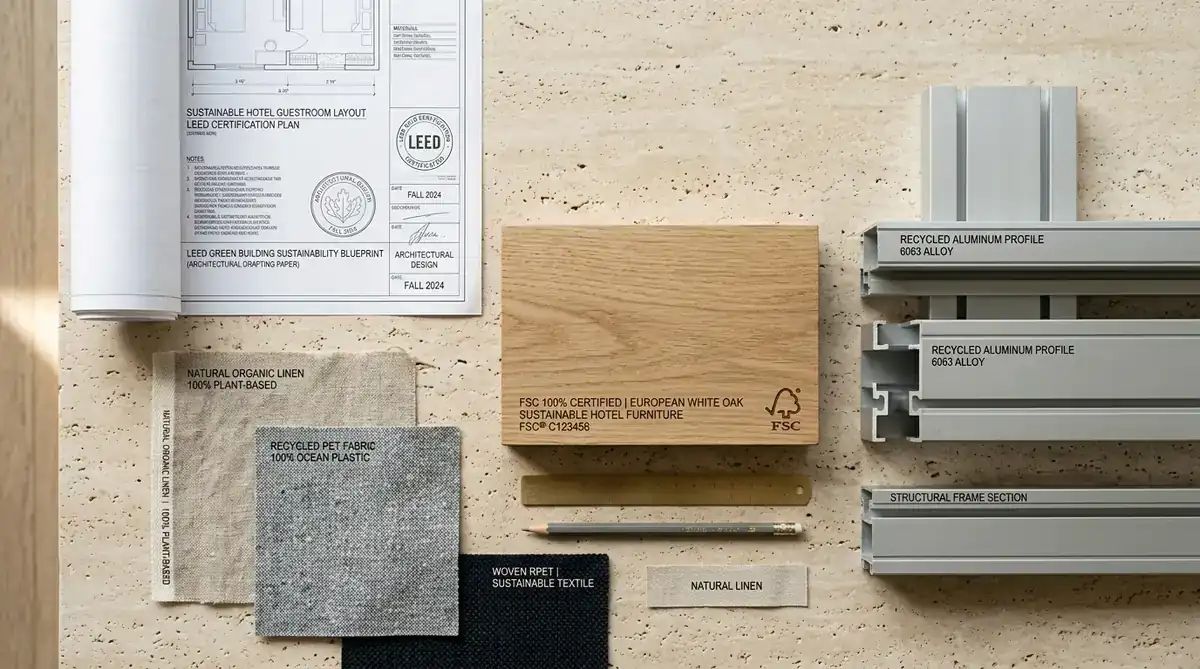
Two sourcing routes for the same 300-key hotel produce 135 tonnes of CO₂e and 36 tonnes for identical rooms. The gap comes from three inputs: where the timber was cut, whether the aluminium is primary or recycled, and how far the freight travelled. That figure does not stay with the furniture maker — it lands on the owner’s greenhouse gas inventory as Scope 3 Category 1, purchased goods and services. The GHG Protocol sets no default factor for contract furniture, so whether the line carries a measured ISO 14067 footprint or an industry average depends entirely on what the supplier can document, which is the same evidence a green building submission asks for. Secondary databases are conservative by design, and they read worse than a real measurement.
In hotel new-builds and PIP renovations, loose FF&E and fixed millwork account for of total interior fit-out Embodied Carbon. Under the Greenhouse Gas Protocol (GHG Protocol), this falls directly within Scope 3 Category 1: Purchased Goods and Services. When developers procure unverified timber, toxic VOC finishes, or carbon-intensive virgin metals, projects fail LEED v4.1 and WELL v2 certification thresholds, exposing owners to severe carbon tax liabilities and debt margin penalties.
Sunder integrates B2B Value Engineering (VE) and ISO 14067 Life Cycle Assessment (LCA), standardizing 100% FSC certified timber, low-carbon recycled alloys, Type III EPD declarations, and circular Design for Disassembly (DfD) — four claims, each tied to a document an auditor can pull.
1. GHG Protocol Scope 3 Category 1 Embodied Carbon Mathematical Model
The Cradle-to-Gate embodied carbon footprint of contract furniture is modeled as:
+-------------------------------------------------------------------------+
|     Cradle-to-Gate Embodied Carbon Lifecycle Flow Architecture (ISO)    |
+-------------------------------------------------------------------------+
|  [FSC Certified Sustainable Forestry] ──► Biogenic Carbon Sink Credit   |
|         │                                 (~0.90 t CO₂e / m³ timber)    |
|         ▼                                                               |
|  [Recycled Aluminum (>=80% Recycled)] ──► Energy is 5% of virgin metal  |
|         │                                 (95% Decarbonization)         |
|         ▼                                                               |
|  [Ecological MDI Zero-Formaldehyde Binder] ──► JIS F☆☆☆☆ (<=0.3 mg/L)   |
|         │                                                               |
|         ▼                                                               |
|  [Design for Disassembly (DfD)] ──► 88% Recyclable ➔ Type III EPD Cert  |
+-------------------------------------------------------------------------+
+-------------------------------------------------------------------------+
| Embodied Carbon Benchmark: Uncertified vs. Sunder Scope 3 Low-C |
+-------------------------------------------------------------------------+
| Guestroom FF&E Embodied Carbon (kg CO₂e / Room) |
| ▲ |
| 600│ / [Conventional Uncertified] |
| │ / (Virgin metals + Urea glue) |
| 450│ / (Generates 150t Carbon Debt) |
| │ ───────────────────────────────── |
| 120│ [Sunder Scope 3 Decarbonized FF&E] ═════════════════════════════ |
| │ (100% FSC + Recycled Alloys + Carbon Sink ➔ 120 kg CO₂e, -73%) |
| 0└──┴──────────────────────────┴──────────────────────────► Vector |
+-------------------------------------------------------------------------+2. 4 Core ESG Sustainable Contract Furniture Manufacturing Standards
Sunder quantifies ESG decarbonization metrics across all production workflows:
1. 100% FSC Chain of Custody (CoC) Certified Timber
- All solid wood and multi-ply birch substrates hold third-party FSC-STD-40-004 certification. Every production lot carries a unique CoC traceability code logging sustainable forestry origins.
2. ≥ 80% Recycled Aluminum & Non-Toxic PVD Ion Plating
- Metal subframes deploy high-fraction recycled aluminum alloys requiring only of the energy intensity of primary smelting; replaces electroplating with zero-effluent physical vapor deposition (PVD).
3. Medical-Grade MDI Formaldehyde-Free Binders & UV Finishes
- Eliminates Urea-Formaldehyde adhesives, deploying MDI polyurethane ecological binders achieving Japan’s strictest JIS F☆☆☆☆ () emissions with TVOC off-gassing .
4. Circular Design for Disassembly (DfD) & Type III EPD Declarations
- Connections utilize standardized mechanical fasteners with laser-etched material identification codes (e.g.,
>PA66-GF30<), achieving a post-consumer recyclability rate backed by certified ISO 14025 Type III EPD declarations.
3. LEED v4.1 & WELL v2 Green Building Credit Matrix
Sunder Green Casework Compliance with Global Rating Systems
| Rating System | Code / Credit Requirement | Sunder Specification |
|---|---|---|
| LEED v4.1 BD+C/ID+C | MRc: Sourcing Raw Materials | 100% FSC Timber (1-2 Pts) |
| LEED v4.1 BD+C/ID+C | EQc: Low-Emitting Materials | BIFMA M7.1 VOC (1-3 Pts) |
| WELL v2 Standard | Feature X06: VOC Limits | JIS F☆☆☆☆ (Precondition) |
| WELL v2 Standard | Feature M02: Sustainable | Halogen/DEHP-Free (1-2 Pts) |
4. Actuarial Quantification: 300-Key Hotel Scope 3 ESG Financial Model
Actuarial 10-year ESG model for a 300-key international luxury hotel:
300-Key Hotel Scope 3 Decarbonization & Green Finance Actuary
| ESG Financial Metric | Conventional Sourcing | Sunder Scope 3 |
|---|---|---|
| Total FF&E Embodied Carbon | 135 Metric Tons CO₂e | 36 Tons (-73%) |
| LEED / WELL Rating Status | Failed / Bronze Cap | Platinum Secured |
| Green Loan Interest Spread Rebate | NT$ 0 (No rebate) | NT$ 3,600,000+ |
| Fortune 500 Corporate RFP ADR | Standard Baseline | ADR +6% to +10% |
| 10-Year Corporate RFP Revenue | NT$ 0 | +NT$ 21,600,000 |
| Carbon Tax Outlay (NT$500/t) | NT$ 67,500 | NT$ 18,000 |
| 10-Year Net ESG Wealth Created | Severe Carbon Liability | +NT$ 25,200,000 |
Sunder’s Scope 3 green procurement cuts modelled embodied carbon by 73%. The table above is a model, not a measurement: 300 keys, a carbon fee of NTD 500 per tonne, a 20 bps green loan rebate, a 6% ADR uplift on corporate travel contracts, and a 7% discount rate. Change the fee or the rebate and the NTD 25,200,000 figure moves with it.
5. Total Cost of Ownership (TCO): High-Carbon Import vs. Sunder Scope 3 VE
10-Year TCO Evaluation: Conventional Sourcing vs. Sunder Scope 3 VE
| Evaluation Vector | Conventional Sourcing | Sunder Scope 3 Spec |
|---|---|---|
| Carbon Data Audit Trail | Black-box, unverified | 100% ISO 14067 EPD |
| Timber Provenance | Uncertified tropical timber | 100% FSC Certified |
| Metal Chemistry | Primary smelting + plating | >=80% Recycled+PVD |
| Green Building Rating | Zero points contributed | Platinum Enabler |
| 10-Year Cumulative TCO | Baseline (100% + Carbon Tax) | Reduced to 29% |
6. Conclusion: Engineering Sustainability into Institutional Asset Resilience
In the global era of institutional ESG governance and fiduciary accountability, premier real estate assets are defined not by wasteful consumption, but by leveraging material science and circular economy principles to engineer custom FF&E into enduring carbon sinks that enhance guest wellness and expand portfolio equity.
Sunder embeds 100% FSC chain-of-custody tracking, recycled alloys, Type III EPD declarations, and Design for Disassembly directly into manufacturing. Two limits belong in the same paragraph. An EPD covers the product and the production line, not the building’s operational energy, and the biogenic carbon credit only holds where the chain of custody survives audit. Where a project’s decarbonization gap sits mainly in HVAC or grid supply, FF&E moves the total by a few percent, not by a third.