Executive Summary
Technical evaluation of executive leather seating, focusing on structural base testing, flammability standards, and TCO.
Spatial Philosophy & Architectural Narrative
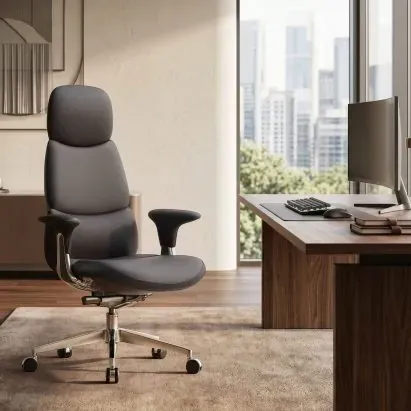
High-end hospitality and executive suites require furniture to serve as functional hubs that blend visual aesthetics with physical zoning. The architectural narrative of modern executive seating centers on spatial scale and ergonomic posture within varied lighting conditions. A high-back profile, paired with a cast aluminum alloy base, forms a micro-environment of privacy within open-plan executive lounges or guestroom workspaces. From a design perspective, the organic curves of leather upholstery contrast with the industrial precision of the metal base, defining a structured visual hierarchy. This textural juxtaposition absorbs light, reducing visual glare under diverse color temperatures and maintaining a professional, focused atmosphere. The physical volume of the seating is calibrated to maintain sightlines across hospitality suites while providing physical support, successfully integrating ergonomic performance with the broader spatial design. By treating the chair as an architectural micro-structure, it anchors the writing area and defines the workspace boundary, allowing designers to establish clear interior zoning without erecting solid partitions.
Luxury FF&E Material Engineering & Joinery Breakdown
From an engineering perspective, the structural integrity of this executive seating rests on the integration of premium materials and rigorous joinery standards. The base structure is constructed from gravity-cast aluminum alloy with a tensile strength exceeding 250 MPa, finished with a PVD (Physical Vapor Deposition) anti-fingerprint coating to prevent surface oxidation under high-frequency contact. The internal shell utilizes a heat-molded 12 mm multi-layer composite plywood, certified to F1-class low-formaldehyde standards, ensuring structural stability under dynamic load testing. For the upholstery, full-grain aniline leather is specified, maintaining a coating thickness below 0.05 mm to preserve natural breathability. The material must surpass 40,000 cycles on the Martindale wear test without piling or fiber breakage, and fully comply with BS 7176 Medium Hazard flammability standards, specifically passing the Crib 5 thermal release test (5.2 kW). The leather panel seams are executed using double-needle stitching, with 8 to 10 stitches per 25 mm and a stitch-spacing tolerance of less than ±0.2 mm. High-tensile nylon thread (minimum tensile strength of 120 N) is utilized to prevent seam slippage. Beneath the leather, a non-woven stress-relief barrier is installed over high-density, fire-retardant molded polyurethane foam (density >= 55 kg/m³, indentation load deflection of 65%) to mitigate leather stretching and surface wrinkling over extended use. The mechanical tilt and elevation hardware are seamlessly integrated within the aluminum housing. The pneumatic gas lift cylinder must comply with DIN 4550 Class 4, verified through 120,000 cycle durability testing to ensure smooth damping without hydraulic oil leakage. Furthermore, all load-bearing connections utilize pre-embedded high-tensile carbon steel threaded inserts rather than direct wood screws, eliminating the risk of thread stripping or joint loosening under prolonged cyclic stress, thereby maintaining structural stiffness. To further enhance the structural durability, the armrests are integrated directly into the main cast aluminum frame, eliminating mechanical lever arm weakness. The internal lumbar support system features a dynamic flex-plate made of glass-fiber reinforced polyamide, which adjusts to user weight distribution without relying on complex, failure-prone spring coils. Underneath the molded foam, all structural webbing consists of high-strength elastomeric bands stretched at a tension of 350 N, secured with heavy-duty steel staples spaced at 15 mm intervals. This triple-layer padding assembly ensures that the seat retains its profile even after continuous 24-hour shift operations. All metal-to-metal joints are fitted with self-lubricating PTFE washers to prevent squeaking or friction wear over millions of oscillations. This comprehensive approach to joinery and material selection guarantees that the product meets the highest mechanical performance standards required for high-occupancy commercial and hospitality environments.
Hospitality Operations, Wear Analysis & TCO Model
In high-traffic five-star hotels and luxury executive suites, the wear and tear of FF&E directly affects operational profitability. Common wear patterns for executive chairs include torn leather on armrests from desk collisions, pneumatic cylinder failure, squeaking mechanical joints, and localized foam sagging. While low-cost options reduce initial capital expenditure (CapEx), they inevitably escalate operational expenditure (OpEx). This financial analysis utilizes the Total Cost of Ownership (TCO) model: TCO = Initial CapEx + (Annual Maintenance Cost × Lifecycle) + (Replacement Cost × Replacement Frequency). Specifying seating compliant with ANSI/BIFMA X5.1 standards increases initial CapEx by approximately 35% compared to standard office chairs, but extends the operational lifecycle from 2 years to over 7 years. Low-grade chairs typically require at least two component replacements or total disposal within 5 years due to structural failures, generating total maintenance costs that exceed 1.5 times the original purchase price. Conversely, utilizing a DIN 4550 Class 4 pneumatic cylinder and high-performance leather keeps the annual replacement rate below 3%, requiring only basic leather conditioning and minor mechanical lubrication. Financial simulations demonstrate that selecting high-specification seating yields a 28% reduction in TCO over a 7-year cycle, effectively optimizing Net Operating Income (NOI) and protecting the long-term valuation of commercial hospitality assets. This cost efficiency is crucial for asset managers calculating internal rate of return (IRR) on capital improvements, proving that upfront investment in certified structural components translates directly to bottom-line savings and sustained guest satisfaction ratings.
Sunder Engineering Grounding & Subtropical Climate Defense
In the subtropical high-humidity environment of the Asia-Pacific region, where relative humidity routinely hovers between 75% and 85%, moisture defense is critical during factory fabrication. First, all wood-based substrates must undergo secondary kiln drying to lock the moisture content strictly within the 8% to 12% range, matching the regional equilibrium moisture content. Second, all cut edges and plywood profiles require double-sided moisture-barrier sealing using a high-solid polyurethane (PU) sealer to block vapor transmission, preventing substrate swelling that causes leather wrinkling or delamination. For metal-to-leather interfaces, a mold-resistant, eco-friendly contact adhesive containing anti-microbial additives must be applied. All leather panels undergo anti-fungal treatment before wrapping, followed by a 48-hour dehumidification phase in the factory. Finished products are vacuum-packed with high-grade desiccant packets in thick moisture-proof polyethylene bags. During on-site installation, indoor relative humidity must be maintained below 60%. Implementing modular pre-assembly methods minimizes on-site joinery and gluing, isolating sensitive internal mechanical components and natural leather from local atmospheric moisture. This preventative engineering strategy guarantees that physical tolerances and material integrity are preserved, preventing costly post-installation remediation or premature replacement of premium leather seating.
B2B Material & Inspection Specification Table
During the project handover and FF&E quality control phase, a standardized inspection matrix is essential. The following table details the key material and execution criteria for executive seating:
| Component | Specification | Inspection Standard | Tolerance & Criteria |
|---|---|---|---|
| Gas Lift & Mechanism | Carbon steel chrome-plated, Class 4 cylinder, >= 2.5 mm anti-explosive plate | DIN 4550 Class 4 / ANSI BIFMA X5.1 | 120,000 cycles without leakage; height tolerance <= 1 mm |
| Leather Upholstery | Full-grain aniline cowhide, water-based PU protective coating <= 0.05 mm | ISO 12947-2 / BS 7176 Crib 5 | Wear resistance >= 40,000 cycles; flammability passes Crib 5 |
| Cast Aluminum Base | Gravity-cast aluminum alloy, PVD titanium finish or anti-fingerprint layer | ASTM B117 Salt Spray / EN 12520 | 240-hour salt spray without corrosion; tensile strength >= 250 MPa |
| Molded Foam Padding | High-density fire-retardant molded polyurethane foam | ISO 3386 / California TB117 | Density >= 55 kg/m³; hardness tolerance <= ±5% |
| Seams & Stitching | High-tensile 3-ply nylon thread, double-needle lockstitch | ISO 4916 Seam Strength | 8-10 stitches per 25 mm; stitch alignment tolerance <= ±0.5 mm |
QC managers must randomly inspect 5% of deliveries, verifying seam consistency and checking metal finish hardness, ensuring that all physical assets comply with commercial hospitality standards.