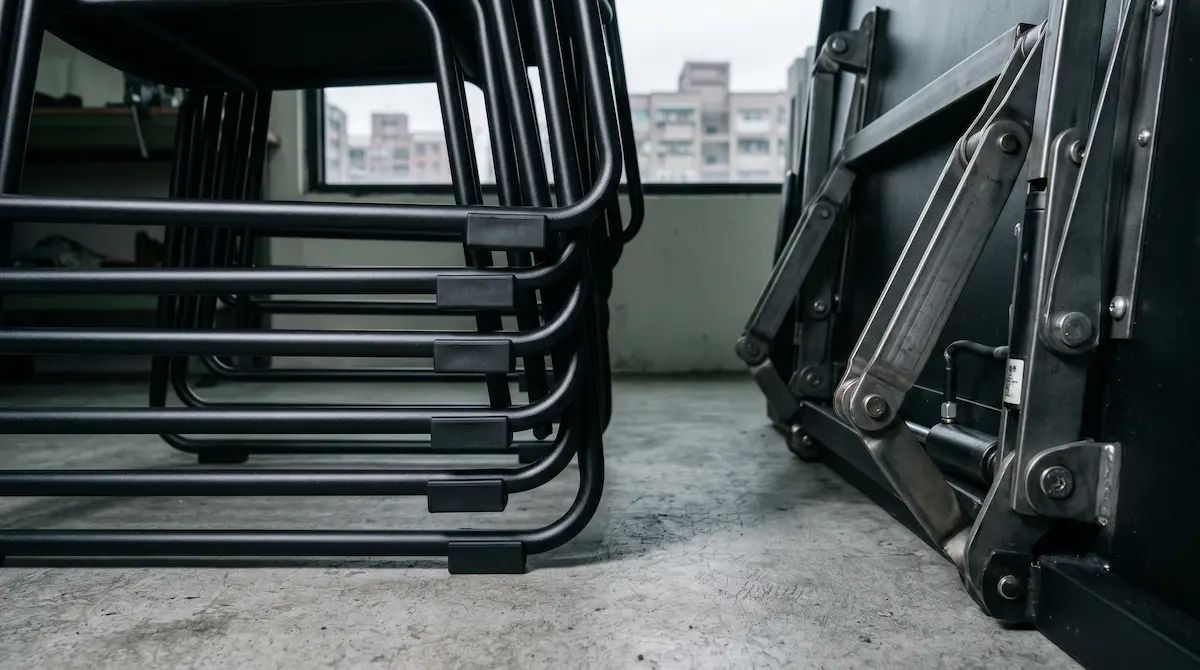
A banquet chair specification usually comes down to two defensible answers: stack it tight, or sit in it for three hours. The tight-stacking answer buys density from an 88 degree tapered tube and a thin seat pan, which is how a nesting pitch under 100 mm and a 40-chair column become possible at all; the comfort answer adds seat-frame section and foam, and its stack usually stops around 10 to 12. What separates them on site is not the product photo but two measurable numbers: plumb-line deviation at full stack height, and overturning angle once the column is on a dolly. Below roughly 15 degrees of overturning angle, a loaded column needs a second person to steady it through a corridor turn, and the labour saving the chair was specified for disappears.
A single 1,000-square-meter pillarless grand ballroom must host an 800-delegate international keynote forum in the morning, and seamlessly turn around within a strict 2-hour window into a 60-table luxury gala dinner in the evening. This rapid scene transition demands that B2B procurement strategies specify commercial furniture against two numbers at once: static load capacity when deployed, and folded depth when stored.
However, standard low-cost folding tables and stacking chairs fall into a structural trap: flimsy sheet-metal hinges that wobble under heavy dinnerware, chairs that topple when stacked beyond 10 units due to center-of-gravity drift, metal-on-metal scratching that leads to oxidation, and low-density storage footprints that consume dozens of square meters of prime back-of-house storage (effectively paying premium square-meter rent to store empty air).
Sunder integrates B2B Value Engineering (VE) and Four-Bar Linkage Kinematics, standardizing 40-chair vertical stacking geometry and gas-assisted heavy-duty flip mechanisms to maximize load capacity and floor space yield.
1. Spatial Turnover Velocity & Storage Floor Space Yield Actuarial Model
In hospitality asset management, ballroom profitability is dictated jointly by event turnaround velocity and back-of-house storage efficiency:
+-------------------------------------------------------------------------+
|     Banquet Space Turnover: Conventional Low-Density vs. Sunder Stacking|
+-------------------------------------------------------------------------+
|  【Conventional Low-Spec Stacking (Center-of-Gravity Drift)】           |
|   Stacking Limit: Only 8 ~ 10 Chairs ──► CG Drifts > 150mm (Topples)    |
|   500 Chairs consume 148 m² (45 ping) of storage ➔ Extreme space waste  |
|                                                                         |
|  【Sunder Ultra-High-Density Stacking (Vertical Plumb-Line Lock)】      |
|   Stacking Limit: 40 Chairs ──► Vertical Plumb Deviation <= 2mm         |
|   (Overturning Angle >= 15°, Stable in transit on transport dolly)      |
|   500 Chairs consume only 50 m² (15 ping) ➔ Frees 98 m² prime space!    |
+-------------------------------------------------------------------------+
+-------------------------------------------------------------------------+
| 40-Chair Vertical Stacking Moment Balance & PTFE Armor Model |
+-------------------------------------------------------------------------+
| ▲ |
| ││ [Chair #40 at Top of Stack] |
| ││ ├── Embedded Heavy-Duty PTFE Teflon anti-scratch bumper pads |
| ││ └── Precision 88° Trapezoidal CNC tubing (Zero lateral play) |
| ││ |
| ││ [Chair #1 at Base] ──► Grade-304 / Q235B 360° Welded Base (>=250kg) |
| └┴───────────────────────────────────────────────────────────────── |
| [Heavy-Duty Transport Dolly] ➔ 1 Person effortlessly maneuvers 40 |
| chairs (200kg gross weight) through service elevators and corridors |
+-------------------------------------------------------------------------+2. 4 Core Heavy-Duty Commercial Turnover Joinery & Mechanism Details
Sheet-metal hinges fail by elongating the rivet hole under repeated folding. The four specifications below address that mechanism:
1. 40-Chair Ultra-High-Density Vertical Stacking Mechanics
- Fabricated from cold-drawn seamless steel tubing (wall thickness ) with 5-axis CNC bent interlocking tapers.
- Tubing profiles incorporate internal PTFE Teflon isolation pads, eliminating metal-to-metal friction. Stacking 40 chairs reaches a height of only with plumb line deviation and an overturning stability angle .
2. Heavy-Duty Four-Bar Gas-Assisted Flip-Top Nesting Tables
- Banquet and seminar tables deploy four-bar mechanical linkages coupled with German pneumatic dampers, enabling single-handed tabletop vertical folding.
- Folded profile thickness is compressed to with longitudinal nesting pitch . When locked flat, dual mechanical safety pins support of uniform static load with zero deflection.
3. Ergonomic Heavy-Duty Transport Dollies
- Each dolly features 4 industrial-grade dual-bearing polyurethane (PU) silent casters, allowing one staff member to move 40 chairs or 10 folding tables across carpet and into service elevators. That assumes a route gradient under 1:12 and a lift car at least 2.0 m deep; where the only back-of-house route is a short-side goods lift, or the path crosses a threshold step, drop the working stack to 25 to 30 chairs.
4. Modular Interlocking Ganging Connectors
- Auditorium and seminar seating incorporate concealed drop-lock ganging clips, aligning hundreds of chairs in laser-straight rows with single-touch engagement.
3. Actuarial Quantification: 500-Guest Ballroom Turnover Time & Space Yield
Actuarial labor and space analysis for a luxury hotel grand ballroom operating 500 banquet chairs and 50 round folding tables:
500-Guest Ballroom Turnover Labor Hours & Revenue Yield Actuary
| Actuarial Parameter | Conventional Low-Spec | Sunder Engineered |
|---|---|---|
| Turnaround Crew Required | 6 Strong Technicians | 2 Housekeeping |
| Turnaround Duration / Event | 120 Minutes (2.0 hrs) | 30 Minutes (0.5) |
| Total Labor Hours per Turnover | 12.0 Man-Hours | 1.0 Man-Hour |
| Annual Turnover Events (250x) | 3,000 Labor Hours / Yr | 250 Hours / Year |
| Direct Annual Labor Saved | Baseline | Saves NT$ 825k |
| Back-of-House Storage Required | 148 m² (45 Ping) | 50 m² (15 Ping) |
| Freed 98 m² Converted to Dining | NT$ 0 (Dead Storage) | +NT$ 1.8M Revenue |
| 5-Year Cumulative Net Yield | Baseline | Exceeds NT$ 13M |
The table models 500 chairs, 50 tables, 250 turnovers a year, labour at NTD 300 per hour, and the released 98 m² valued at NTD 5,000 per ping per month, which totals roughly NTD 13,000,000 over five years. It is a model, not a measurement: change the turnover count or the floor yield and the figure moves, though the direction of the labour-hour and floor-area gaps usually does not.
4. ANSI/BIFMA X5.1 / X5.5 Mechanical Strength & Turnover Standards
Contract Turnover Furniture Structural Compliance Matrix
| Inspection Vector | Testing Standard | Sunder Passing Spec |
|---|---|---|
| Mechanism Cycling | ANSI/BIFMA X5.5 Cycling | 20,000 Silent Cycles |
| Static Table Load | 250 kg Distributed Force | Zero Joint Deflection |
| Base Stacking Load | 39 Chairs Dead Weight Load | Zero Structural Buckling |
| PTFE Pad Friction | ASTM D4060 Taber 10k Cyc. | Zero Finish Gouging |
| Dolly Dynamic Drop | 200kg Full Load 10mm Drop | Zero Wheel Axis Fatigue |
5. Total Cost of Ownership (TCO): Conventional Stacking vs. Sunder Engineering
10-Year TCO Evaluation: Low-Spec Folding vs. Sunder High-Density VE
| Evaluation Vector | Low-Spec Folding / Stack | Sunder High-Density |
|---|---|---|
| Turnover Efficiency | Slow (2 hours, high labor) | Rapid (30 min, 1 man) |
| Paint Chipping / Rust | Scratches after 5 stacks | PTFE Zero Scratches |
| Mechanism Failure Rate | Hinges deform under load | 20k-Cycle Proofed |
| Storage Area Footprint | 148 m² (Severe dead space) | 50 m² (-65% Footpr) |
| 10-Year Cumulative TCO | Baseline (100% + Scrap) | Reduced to 28% |
6. Conclusion: Engineering Spatial Agility into Institutional Balance Sheets
In modern luxury hospitality and convention asset management, banquet furniture is not inert warehouse storage; it is active production equipment that directly dictates daily ballroom turnover frequency (Flips/Day), square-meter floor yield, and frontline labor costs.
Sunder unites four-bar linkage kinematics, 40-chair vertical stacking geometry, and PTFE friction isolation into contract manufacturing lines. Before signing a stacking chair order, ask for the plumb-line deviation measured at full stack height and the ANSI/BIFMA X5.5 cycling report for the folding mechanism. Those two documents separate mechanism grades more reliably than a claimed stack count does.
Further Reading
- Commercial Sofa Ergonomics & Durability Engineering: High-Resilience Foam (≥ 45 kg/m³), Sinuous Spring Tension, and Structural Biomechanics
- ESG Sustainable Hotel Furniture Procurement & Scope 3 Decarbonization: FSC Certified Timber, Circular Economy, and LEED/WELL Green Building Credits
- Commercial Fire-Retardant Hotel Furniture Procurement & Regulatory Compliance Guide: BS 7176 / BS 5852 Crib 5 Testing, Inherent FR Yarns, and 10-Year TCO Defense