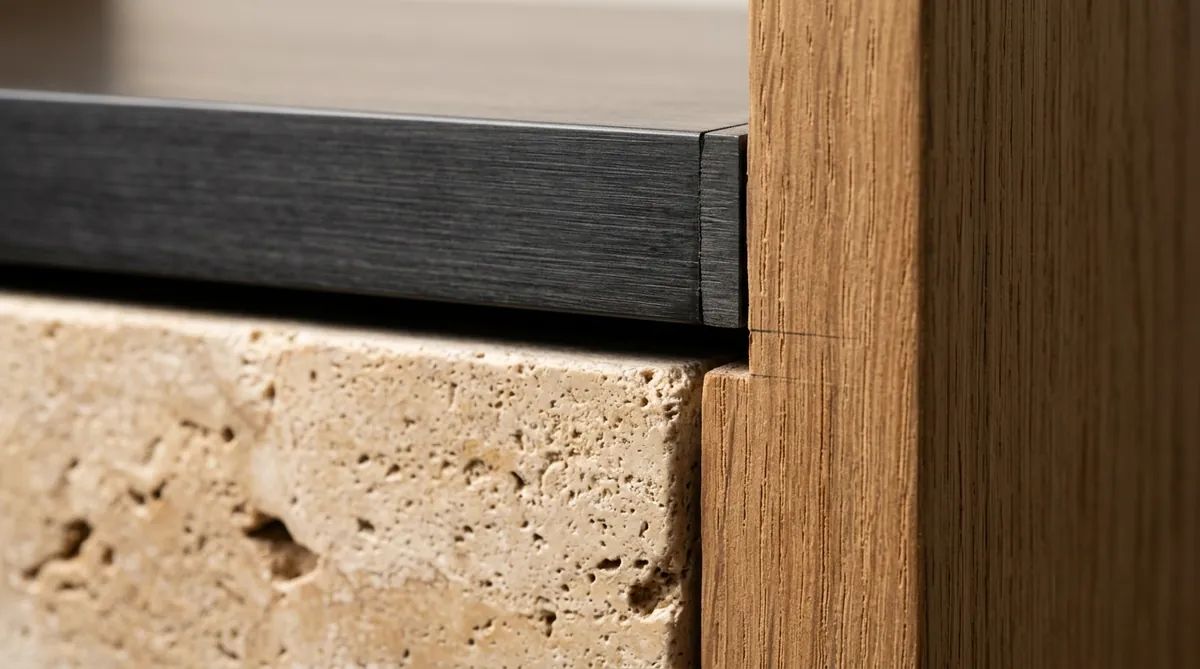
At nine on installation day the stone top lands on its metal frame, a fingertip runs across the timber-metal-stone seams and finds no step, and the sign-off sheet gets initialled. By four in the afternoon the HVAC has pulled the room down to 20°C and the same seam can be felt. A 2,000 mm run of 304 stainless contracts about 0.52 mm across a 15 K swing, while the timber substrate beside it moves the other way on humidity alone. That is not workmanship; it is three materials with different expansion coefficients sharing one edge. Whether the seam opens depends on whether that movement has somewhere to go.
However, in material physics and commercial furniture manufacturing, multi-material joinery is a severe thermodynamic and hygroscopic battle. Metal, stone, and timber possess radically disparate expansion and contraction coefficients. When conventional factories attempt rigid mechanical fastenings using standard wood glue and rigid screws, 24/7 commercial HVAC cycling combined with high-humidity maritime climates generates internal destructive shear stresses exceeding within 6 to 12 months. This triggers stone fracture, veneer blistering, delamination, and jagged tactile offsets.
Sunder utilizes B2B Value Engineering (VE) and Stress-Relief Interface Mechanics to neutralize material conflicts through precise CTE compensation, strict Equilibrium Moisture Content (EMC) calibration, and micro-expansion elastic joints, so that seasonal movement is absorbed in the joint rather than in the finish.
1. Physical Constant Conflicts: Coefficient of Thermal Expansion (CTE) vs. Hygroscopic Swelling
When composite materials experience temperature and humidity shifts, their dimensional behaviors diverge fundamentally:
- Metals and Natural Stone: Governed primarily by temperature via the Linear Coefficient of Thermal Expansion ().
- Solid Timber and Veneers: Governed simultaneously by temperature and ambient Relative Humidity (RH), where transverse tangential fiber swelling () vastly exceeds longitudinal expansion.
Composite Dimensional Variation Equation:
Thermodynamic & Hygroscopic Constants Across Core Substrates
| Material Class | CTE (α, 10^-6 /K) | Hygroscopic Swelling (β, %/ %MC) |
|---|---|---|
| 304 Stainless | 17.3 x 10^-6 | 0.00% (Non-hygroscopic) |
| Natural Marble | 5.5 ~ 8.5 x 10^-6 | 0.01% (Negligible moisture gain) |
| American Walnut | 4.5 x 10^-6 (Grain) | 0.25% ~ 0.35% (Tangential grain) |
+-------------------------------------------------------------------------+
|         Destructive Shear Stress Under Rigid Fastening Mechanics         |
+-------------------------------------------------------------------------+
|   [ Natural Marble Top (CTE = 6.0) ]  ──► Rigid & brittle, fractures    |
|   ═════════════════════════════════════════════════════════════════════  |
|   [ Rigid Epoxy / Standard Wood Glue ] ──► Zero yield, shear exceeds    |
|                                            15 MPa, rupturing bondline   |
|   ═════════════════════════════════════════════════════════════════════  |
|   [ 304 Stainless Frame (CTE = 17.3) ]──► Expands 3x faster in summer   |
|   ─────────────────────────────────────────────────────────────────────  |
|   [ Hardwood Plywood Core (Swelling) ]──► Shrinks under dry winter HVAC |
+-------------------------------------------------------------------------+
When guestroom HVAC shuts down, shifting ambient temperatures from to (), a stainless steel frame contracts by , while adjacent timber substrates expand by over due to humidity. With rigid fastening there is nowhere for that difference to go, so the bondline and the finish absorb it.
2. Sunder Micro-Expansion Joint Engineering: 3-Tier Interface Mitigation
Sunder does not rigidly lock dissimilar materials to one another. At timber-metal-stone intersections we detail a joint that is allowed to move:
+-------------------------------------------------------------------------+
|   Sunder Timber-Metal-Stone 3-Tier Resilient Joint Cross-Section        |
+-------------------------------------------------------------------------+
|             [ 20mm Italian Natural Marble / Quartzite Slab ]            |
|                                │                                        |
|             [ High-Shear Carbon Fiber Mesh + Epoxy Primer ]             |
|                                │                                        |
|       ┌────────────────────────▼────────────────────────┐               |
|       │  1.5mm ~ 2.0mm Micro-Beveled Shadow Expansion Gap │               |
|       │         (Weatherproof Neutral Modified Silicone) │               |
|       └────────────────────────┬────────────────────────┘               |
|                                │                                        |
|             [ Modified Silane (MS) Polymer Adhesive (Elongation >= 300%)]|
|                                │                                        |
|             [ PVD Titanium Grade-304 Trim + Aluminum Extrusion Base ]   |
|                                │                                        |
|             [ E0 / JIS F☆☆☆☆ Marine-Grade Birch Substrate (EMC 8%-10%) ]|
+-------------------------------------------------------------------------+
1. 1.5mm to 2.0mm Micro-Beveled Shadow Expansion Gaps
- Every material intersection features a pre-engineered shadow gap with a precision micro-bevel.
- Joints are sealed with German-engineered neutral-cure modified silicone, providing UV resistance and long-term recovery, sized to absorb thermal movement of the magnitude calculated above.
2. High-Elasticity Modified Silane (MS) Polymer Structural Adhesives
- Bonding layers utilize solvent-free, ultra-low VOC MS polymers with tensile elongation at break and lap-shear strength .
- This creates a resilient interface that permits microscopic slide without bondline rupture, reducing internal peak shear stresses by over .
3. Carbon-Fiber Reinforcement for Natural Marble
- Stone undersides receive a continuous high-modulus carbon-fiber mesh embedded in penetrating epoxy resin.
- This raises the tensile capacity of the slab underside, so natural fissures are less likely to propagate under localized metal thrust. It does not make stone unbreakable, and the fissure pattern in any given slab cannot be known in advance.
3. Equilibrium Moisture Content (EMC) Climate Calibration: 8% - 10% Protocol
Timber is the most hygroscopically sensitive organic material in multi-material systems. Sunder runs a climate calibration protocol tailored for high-humidity subtropical regions and continuous air-conditioned hospitality environments:
+-------------------------------------------------------------------------+
|           Equilibrium Moisture Content (EMC) Lifecycle Control          |
+-------------------------------------------------------------------------+
|  [Step 1: Vacuum Microwave Kiln Drying] --> Raw timber dewatered from   |
|                                             60%+ to exact 8% - 10% range|
|                                │                                        |
|  [Step 2: 72-Hour Climate Conditioning] --> 22°C, 50% RH conditioning to|
|                                             relieve internal fiber stress
|                                │                                        |
|  [Step 3: 6-Sided Hydrophobic Sealing]  --> 6 full coats of polyurethane|
|                                             primer barrier seal         |
|                                │                                        |
|  [Step 4: Pin-Type Moisture Meter QC]   --> 100% inspection; deviation  |
|                                             > +/-1.0% rejected          |
+-------------------------------------------------------------------------+
Six-sided sealing holds timber dimensional change at — on the assumption that the room stays air-conditioned. On floors left unpowered and shut for months, interior humidity returns to ambient and the timber moves with it.
4. Seam Flushness Tolerance & Housekeeping OpEx
Precision interface engineering directly elevates the tactile guest experience while lowering hotel operating expenses:
+-------------------------------------------------------------------------+
|           Tactile Flushness Tolerance vs. Housekeeping OpEx ROI         |
+-------------------------------------------------------------------------+
|  [Tactile Tolerance]  Seam height step deviation strictly <= +/- 0.3mm  |
|                       (Zero fingertip friction or sharp edge drag)      |
|                                                                         |
|  [Zero-Crevice Spec]  Eliminates deep recess dirt traps & bacteria harborage
|                                                                         |
|  [Housekeeping OpEx]  Single-wipe glide cleaning --> 40% faster wipe-down|
+-------------------------------------------------------------------------+
5. Total Cost of Ownership (TCO): Rigid Joining vs. Sunder Elastic Interface Engineering
10-Year TCO Comparison: Traditional Rigid Bonding vs. Sunder Interface
| Evaluation Vector | Traditional Rigid Lock | Sunder Interface |
|---|---|---|
| Seam Height Tolerance | +/- 1.5mm (Uneven step) | CNC <= +/- 0.3mm |
| HVAC Thermal Longevity | Delaminates in 6-12 months | 10 Years Stable |
| Stone Crack Protection | Zero buffer, stone chips | Carbon fiber mesh |
| Timber Moisture Control | No climate calibration | Strict EMC 8%-10% |
| Out-of-Order Room Loss | High (On-site re-sanding) | Zero room downtime |
| 10-Year Cumulative TCO | Baseline (100%) | Reduced to 36% |
6. Conclusion: Harmonizing Material Nature Through Science
In luxury hospitality architecture, true craftsmanship is not merely assembling expensive materials; it is harmonizing conflicting physical behaviors into enduring structural unity through rigorous science.
By integrating material thermodynamics, micro-expansion shadow gaps, and MS structural polymers directly into our manufacturing lines, Where the method runs out is worth stating: semi-outdoor areas with large diurnal swings, and single stone tops spanning more than 3,000 mm, need to be split into separate elements rather than carried by a joint alone. When reviewing shop drawings, ask for the gap width and adhesive type called out at every dissimilar-material interface.