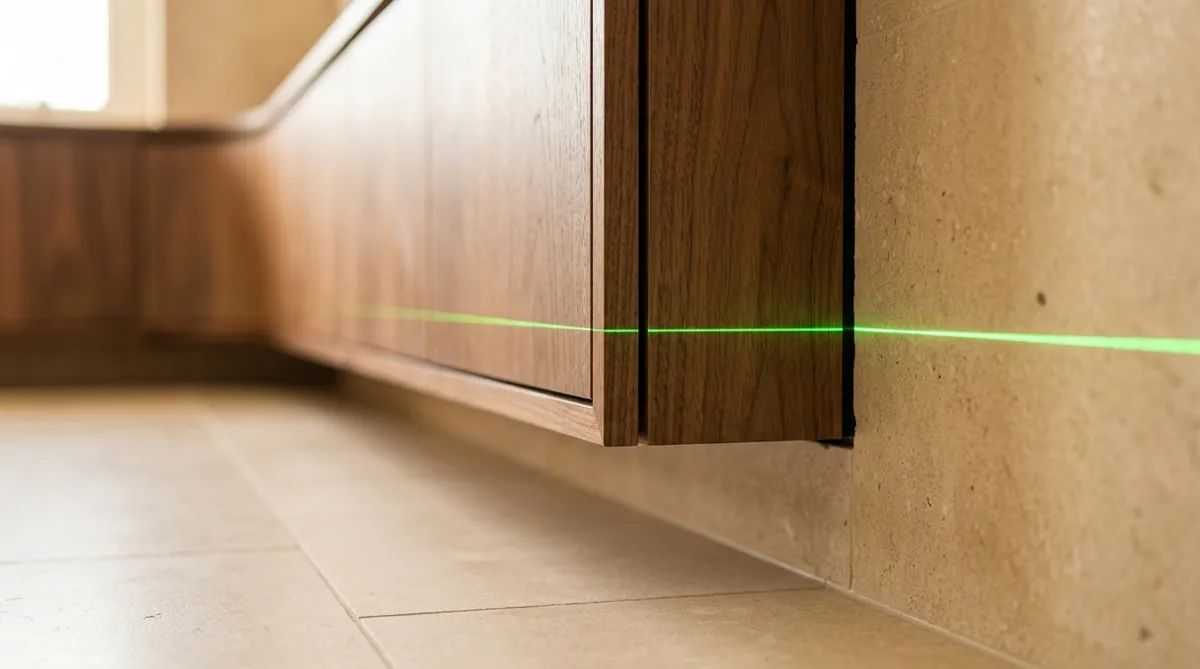
The civil tolerance schedule allows RC wall plumb to deviate by ±8 to ±15 mm. The casework drawing for the same room says ±0.2 mm. Neither document is wrong; they describe two manufacturing processes whose tolerances differ by a factor of 40 to 75. That difference does not go away on its own, and it comes to rest on the line where the cabinet meets the wall. Where a 15 mm shadow gap and a factory-prefabricated aluminum trim were drawn in, it rests in a line that reads as intentional. Where nothing was allowed for, it becomes silicone applied on site, which in a humid subtropical climate yellows and blackens with mold within 6 to 12 months. How wide the gap is, who prefabricates the trim, and which face it lands on are shop-drawing decisions.
In commercial civil construction, statutory verticality tolerances for reinforced concrete (RC) shear walls and drywall partitions range as wide as , with floor slab levelness variations reaching . If furniture manufacturers lack pre-engineered tolerance absorption details, installation crews are left with two field compromises: “Destructive on-site saw trims that void factory edge seals” or “Smearing massive beadings of cheap silicone caulk to bridge 10mm+ gaps.”
In humid subtropical climates, thick silicone caulk degrades, turns yellow, and blackens with fungal mold within 6 to 12 months. Concurrently, unsealed core edges absorb ambient humidity, causing custom casework to swell, delaminate, and fail structurally within 2 to 3 years.
Sunder integrates B2B Value Engineering (VE) and Tolerance Countermeasure Engineering through 3D LiDAR point-cloud surveys, factory-prefabricated shadow subframes, and multi-axis leveling mechanisms, aligning to the building without cutting the factory edge seal.
1. Mechanical Interference of Rigid Casework Against Tilted Structural Walls
When rigid rectangular casework is forced against out-of-plumb building walls without tolerance buffers:
+-------------------------------------------------------------------------+
|            Structural Wall Tilt & Rigid Casework Interference Model     |
+-------------------------------------------------------------------------+
|  [Tilted Concrete Structural Wall]                                      |
|       \ (Verticality deviation Δx >= 12mm)                              |
|        \                                                                |
|         \──────► [12mm gaping void at top ➔ Bridged by massive silicone] |
|          \            │ (Silicone blackens with mold in 6-12 months)    |
|           \           ▼                                                 |
|            \    ┌──────────────────────────────────┐                    |
|             \   │                                  │                    |
|              \  │ [Rigid 90° Factory Casework]     │                    |
|               \ │                                  │                    |
|                \│                                  │                    |
|                 └──────────────────────────────────┘                    |
|                  ▲                                                      |
|                  │ (Base binds against wall, forcing front panel skew)  |
+-------------------------------------------------------------------------+
Forcing cabinetry against out-of-plumb substrates introduces severe torsional shear stresses across carcase boxes. This distorts hinge alignments, causes drawer runners to bind, and creates wavy, un-closable reveal lines across cabinet fronts.
2. Sunder 4-Tier Tolerance Countermeasure & Seamless Detailing System
Sunder standardizes tolerance absorption mechanisms that neutralize architectural deviations invisibly:
+-------------------------------------------------------------------------+
|     Sunder Built-in Millwork 4-Tier Tolerance Absorption (Cross-Section)|
+-------------------------------------------------------------------------+
|  [Concrete Structural Wall]                                             |
|       │                                                                 |
|       ├── 20mm Rear Convective Air Cavity (Prevents wall condensation)  |
|       │                                                                 |
|       ├── [Factory Anodized Aluminum Shadow Trim] (15mm Shadow Gap)     |
|       │                                                                 |
|       └── [Casework Main Body] (E0 / JIS F☆☆☆☆ Core + 6-Sided PUR Seal) |
|                 │                                                       |
|                 └── Heavy-Duty Concealed Levelers (Travel +/-15mm, 250kg)|
+-------------------------------------------------------------------------+
1. 3D LiDAR Spatial Point-Cloud Scanning
Following masonry completion, Sunder deployment teams conduct high-density 3D LiDAR point-cloud surveys across guestroom walls. Millions of spatial coordinates are reverse-engineered into BIM models for “Clash Detection,” allowing CNC routers to pre-profile back-scribes in the factory before finishing.
2. 15mm Architectural Shadow Gap Trims (Shadow Line System)
- Replaces large-section wet caulking with a pre-engineered architectural shadow gap fitted with factory-anodized aluminum subframe extrusions.
- Creates crisp, intentional shadow lines that absorb up to of wall deviation, visually and dimensionally. Beyond that range the trim has to be widened or the run split into separate units.
3. Heavy-Duty Multi-Axis Concealed Levelers
- Casework bases incorporate heavy-duty gear-driven carbon steel leveling feet, each rated for .
- Installers adjust plumb and level over a travel range via concealed internal access ports using an Allen wrench, bringing countertop levelness to within .
4. 20mm Rear Anti-Condensation Convection Cavity
- A continuous rear air gap coupled with plinth intake vents maintains natural airflow, preventing structural wall condensation from transferring into timber backboards.
3. Zero-Crevice Hygiene & Housekeeping Operational ROI
Shadow gap detailing changes two things during operation: the cleaning path and the moisture path.
+-------------------------------------------------------------------------+
|          Seamless Detailing vs. Housekeeping & Asset Preservation       |
+-------------------------------------------------------------------------+
|  [Zero Mold Growth]     Eliminates thick silicone ➔ Completely eradicates|
|                         black fungal mold and foul damp odors           |
|                                                                         |
|  [Faster Housekeeping]  Flush shadow gaps ➔ Zero dirt-trapping recesses |
|                         --> Guestroom wipe-down speed increased by 30%  |
|                                                                         |
|  [100% Moisture Armor]  Zero field sawing ➔ Factory PUR edge seal intact|
|                         --> Water absorption thickness swelling <= 8%   |
+-------------------------------------------------------------------------+
4. Total Cost of Ownership (TCO): Field Modification vs. Sunder Tolerance Engineering
10-Year TCO Comparison: Field Caulking vs. Sunder Tolerance Details
| Evaluation Vector | Field Sawing & Silicone | Sunder Tolerance |
|---|---|---|
| Installation Method | Handheld saw cuts + caulk | 3D LiDAR + Shadow |
| Edge Seal Integrity | Severed on site (Rot risk) | 100% Intact PUR |
| Joint Aging State | Blackens in 6-12 months | 15mm Shadow Line |
| Hardware Action | Box racked, runners bind | Perfect glide |
| Room Downtime Loss | High (Re-caulk every 2 yrs) | Zero room downtime |
| 10-Year Cumulative TCO | Baseline (100% + Replace) | Reduced to 35% |
5. Conclusion: Protecting Asset Value at the Final Mile
In five-star luxury hotels, perceived quality is defined at the final mile of installation. How the crew handles building tolerance on the day decides what that junction looks like two years later, whatever the design intent or the machining tolerance was.
Sunder enforces 3D LiDAR point-cloud surveys, architectural shadow gaps, and multi-axis leveling mechanisms across all built-in joinery. The method has preconditions. The scan is only valid once plaster is complete and partition positions are frozen; if civil work is still moving, the point cloud is stale by the time the CNC runs. And where wall deviation exceeds roughly 20 mm, a 15 mm shadow gap will not take it up, so that case goes back to the design stage for a wider subframe or a split run.
Further Reading
- Hotel Brand Standards & FF&E Compliance Engineering: Marriott, Hilton, and IHG Technical Specifications Unpacked
- Hotel Room Functional Furniture & MEP Integration Engineering: Pre-Routed Wire Management, Thermal Dissipation Channels, and Quick-Release Maintenance in Nightstands, Mini-Bars, and TV Consoles
- Hotel Furniture RFP & Tender Specification Defense: Securing Quality Craftsmanship and Project Delivery Schedules