On a hotel’s financial statements, the largest long-term expense is frequently not the initial construction cost, but the unrelenting Operational Expenditures (OpEx) tied directly to personnel and daily maintenance.
Traditional B2B procurement strategies often focus myopically on the initial visual presentation and the upfront Capital Expenditure (CapEx) of the furniture. This fatally ignores how the hardware will physically interact with housekeepers and maintenance engineers hundreds of times a day over the next five years. Insufficient under-bed clearance, bulky floor-standing TV cabinets, and concealed wiring requiring destructive dismantling to repair—these hidden design flaws silently and continuously bleed the hotel’s labor resources dry.
Sunder’s Value Engineering (VE) regards “Operational Friendliness” as the highest tier of mechanical and geometric engineering. By intelligently restructuring furniture, we effectively slash on-site ineffective labor time, achieving the ultimate suppression of the Total Cost of Ownership (TCO).
The Labor Hour Accumulation Disaster Triggered by Micro-Obstacles
In the rigorous standard operating procedures of housekeeping and maintenance engineering, time is a highly scarce, highly expensive resource.
When commercial furniture features unnecessarily complex carvings, exposed tracks, or floor-standing bases lower than standard sweeping equipment, it creates tangible, physical “cleaning dead corners.” Housekeepers are forced to expend immense physical stamina to constantly bend over or even lift furniture weighing tens of kilograms just to complete basic cleaning. This severely drags down housekeeping efficiency and accelerates employee burnout.
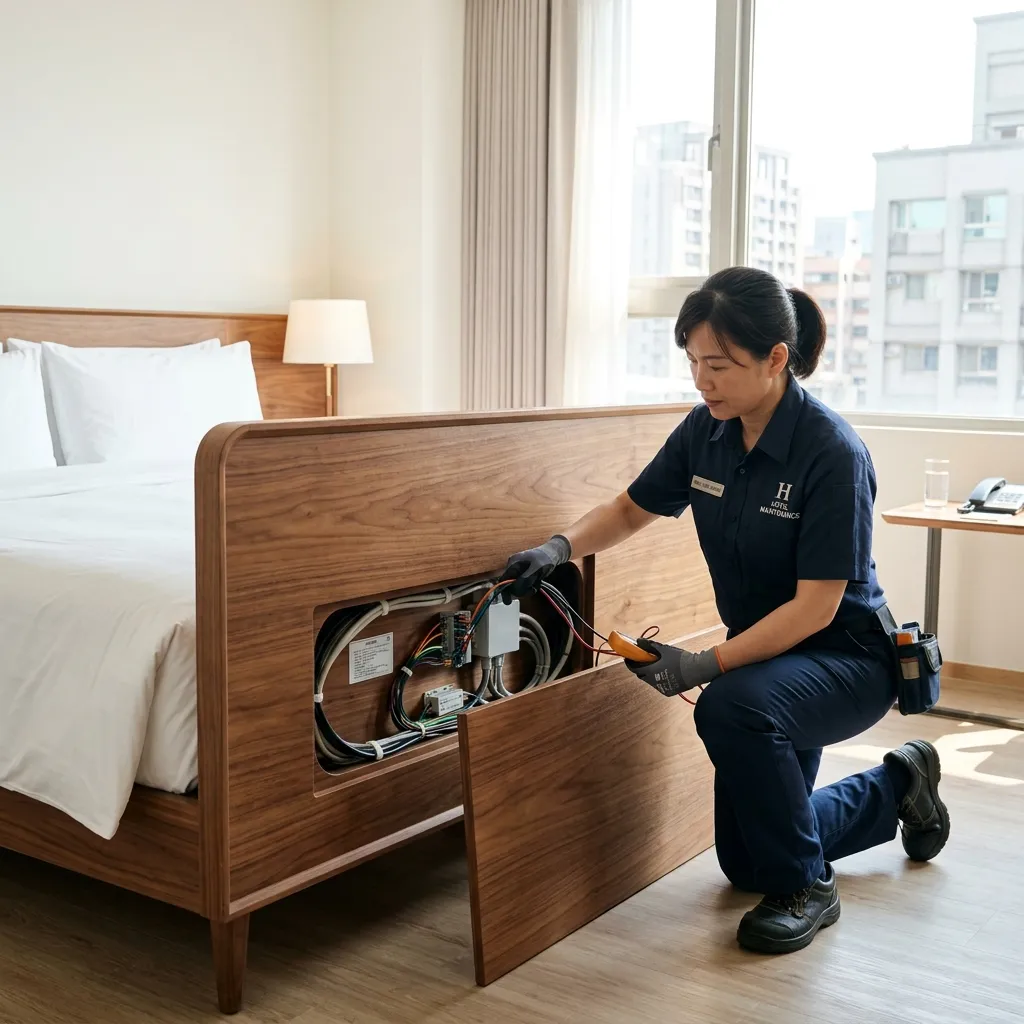
On the maintenance end, if power sockets and weak-current wiring are rigidly sealed behind a permanent headboard, an engineer might need to spend two hours dismantling an entire millwork wall panel just to replace a single fuse or network cable. These extra minutes to hours spent per room, when multiplied across hundreds of rooms and 365 days, compound into an astonishing financial black hole of ineffective labor hours and overtime pay. Simultaneously, it exponentially increases revenue losses due to prolonged Room Out of Order (OOO) downtime.
Massive Deployment of Suspended Configurations and Quick-Release Maintenance Access
To drastically reduce this relentless physical attrition, a high degree of geometric discipline must be introduced during the foundational structural design phase:
- Absolute Suspension and Sweeping Clearance Zones: We strictly mandate the “wall-mounting” of nightstands, desks, and TV cabinets. Through exquisite concealed hardware designs, heavy-duty load-bearing frameworks are embedded into the wall, entirely detaching the furniture from the floor. This creates a 100% obstacle-free floor cleaning path, allowing housekeepers to finish sweeping in a single, frictionless straight-line motion.
- Front-Access Maintenance Channels and Quick-Release Modules: On all large millwork concealing pipelines, we deliberately design front-access maintenance panels equipped with heavy-duty magnetic or quick-release clips. Maintenance personnel can reach the core of weak currents or plumbing for inspection within exactly 15 seconds, without moving the main structure. These highly-sealed quick-release panels effectively block moisture, perfectly meeting the rigorous demands of the Taiwan moisture defense standard.
Compression of Labor Hours and Ultimate TCO Defense
The ultimate, non-negotiable purpose of commercial furniture engineering is the liberation of the labor force.
Compressing the single-room cleaning time for housekeeping and aggressively optimizing maintenance inspection times from “hours” down to “minutes” directly means the hotel can sustain high-standard, premium operations with a significantly leaner workforce.
Incorporating the massive saved labor costs and the hidden mitigation of occupational injury risks into the Total Cost of Ownership (TCO) calculation model mathematically proves that the slight initial budget increase for suspended designs and quick-release modules pays for itself completely within the first quarter of operation. This is a brilliant financial defensive war utilizing internal physical structures to combat exorbitant, escalating personnel costs.
Technical Glossary
- TCO (Total Cost of Ownership): Encompasses not just the initial purchase price (CAPEX), but also the hidden operational costs (OPEX) including installation, maintenance, cleaning, and eventual replacement. Sunder minimizes TCO through extreme engineering.
- FF&E (Furniture, Fixtures & Equipment): All movable furniture and equipment within hospitality and commercial projects. We focus on the durability and asset lifecycle management of FF&E.
- VE (Value Engineering): Achieving the optimal cost-benefit ratio through process optimization and material substitution without sacrificing design aesthetics or structural integrity.